So, um, this is embarrassing. I wrote this article almost immediately after Stahleck finished, then completely forgot to ever publish it. However, having realised that I figure it still has value – we’ve only gained a single deluxe box in the interim period, and there are still no new cards for another 6-8 weeks – I’ve decided to just post it what I’m reliably informed is “fashionably late”. Enjoy!
Another week, another huge tournament. This one, 2018’s Tourney of Stahleck, is the second-largest tournament in the history of the game, and we all know what that means – nerds like me have lots of juicy data to analyse.
A couple of weeks ago I looked at the Worlds stats, and one of the interesting things about having Stahleck so close is that with only one chapter pack’s difference in the metas, we can get a real idea for the differences between a predominantly-American and predominantly-European meta.
As with the Worlds data, I have to make the caveats that the data is grouped by faction not deck archetype, so the likes of a Drowned God deck, a Pillage deck and unopposed deck all come under the banner of “House Greyjoy”. If anyone wants to know a specific faction/agenda combination’s statistics, comment below or send me a private message and I’ll furnish you as best I can.
And now, bring on the bar charts!
Factions
The number in parentheses for each entry is the sample size – so, in the case of Lannister, there were 202 appearances of Lannister decks in games at Stahleck.
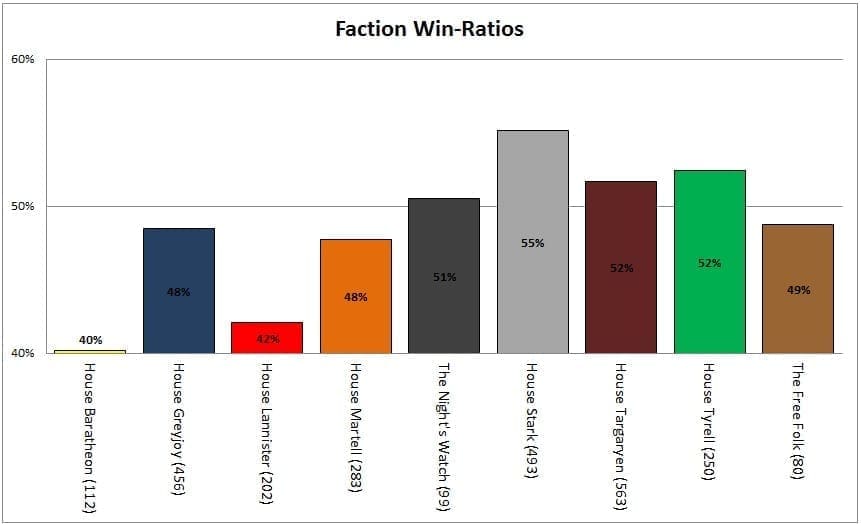
As we can see, Baratheon and Lannister did particularly poorly. This is something I find curious – both factions, though little-fancied going into Worlds, performed pretty admirably. Yet here with a larger sample-size, which would normally make results trend more towards 50%, we instead see both factions do significantly worse. There are only two explanations for this that I can think of: firstly, Bara and Lanni got some strong cards in chapter pack six, but it came too close to the tournament for people to properly figure out how to leverage them; or secondly, this is just where Bara and Lanni are in the meta and Worlds was an anomaly.
At the other end of the scale, House Stark had a tremendous upswing, comfortably proving itself to be the top faction, both in its overall win rate and its presence at the top of the standings of the event. At the risk of being an arrogant so-and-so, this is something I probably have at least partial responsibility for, having published the list that took me to the top four at Worlds. Anecdotally I know several players told me they’d either taken my exact list, or one based on it with a few changes. Obviously Lennart’s worlds-winning Martell Wolf was also published, but in my opinion that list is a lot tougher to get to grips with than the Stark Fealty, and good a list though it was, only Lennart’s unparalleled skill at playing such a deck allowed him to win Worlds. This is perhaps backed up by the respective deck’s individual win-ratios – Stark Fealty had a 57% win-ratio, while Martell Wolf only had a 48% win-ratio. Of course, Stark’s win rate had to do with more than just Fealty, with the deck that won the entire event being Stark Banner Lion.
In other trends from Worlds, Greyjoy, Night’s Watch and particularly Tyrell ticked up, with Martell and Targaryen ticking down. This hardly spells the downfall of Targ though, as they were still the third-most successful faction despite this, and had a highly impressive qualification ratio, being 22% of the field but 31% of the cut. Just when you have that many people playing a deck, law of averages suggests some of them won’t be as good with it I guess.
Agendas
As with Worlds, not every agenda features on this graph. However, being a larger tournament, more agendas had at least one person playing them, so here the only ones not featured are Banner of the Sun, Banner of the Watch, Kings of Winter and The Conclave.
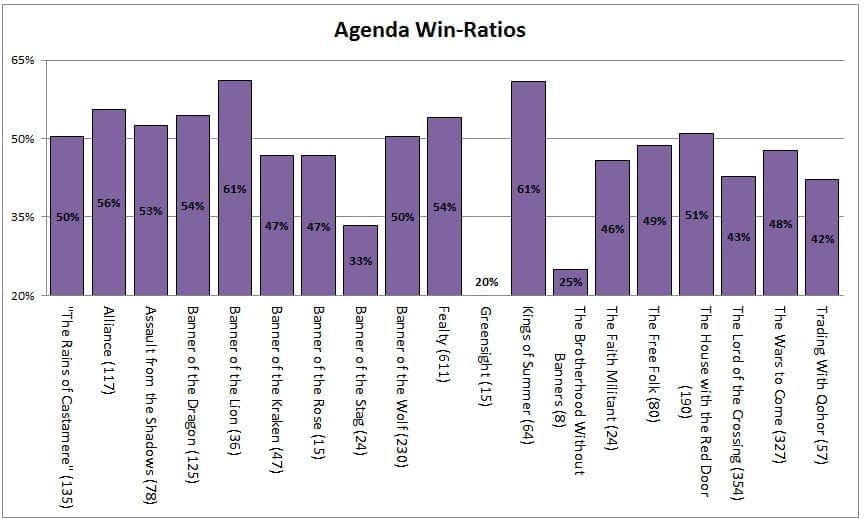
Ignoring some of the more niche agendas that were only included in a couple of low-performing decks, we have a relatively standard spread here, ranging from 42 to 61%. Perhaps unsurprisingly, the two agendas on 61% were played relatively sparsely, but were the agendas of choice for the two finalists, Banner of the Lion and Kings of Summer. These individual performances obviously heavily skew the agendas’ numbers, so I’d rather focus on some of the more heavily-played agendas.
It is very interesting to me that Alliance had 56% win rate, yet Trading with Qohor had a 42% win rate. Please correct me in the comments if I’m wrong, but I believe every Alliance deck in the field included the Qohor agenda as one of its banners. To that end, the results seem to suggest that – at least for the current meta – there is enough draw and consistency that having a wider selection of attachments is more important than having a tighter more efficient decks.
Moving past those, I want to focus on three agendas – Fealty, The House with the Red Door and The Lord of the Crossing. Fealty was the big winner of this event in many ways. It was the most-played agenda, and put up one of the highest win rates of any agenda in the field. As with Stark this may have a little to do with the list that yours-truly posted in between Worlds and Stahleck, but nonetheless it proves that reports of the agenda’s demise earlier this year were very much exaggerated.
On the flipside, that is a poor, poor showing for The Lord of the Crossing. Hyped as the best agenda by some going into Worlds – some were even bandying around the suggestion it needed to be restricted – it has had two outright bad performances in a row. Turns out that all people needed was to build and test with it in mind and they could stop it relatively consistently, who knew?
Lastly, The House with the Red Door. The joint-best agenda at Worlds in terms of win-rate, it took a mighty hit here (albeit still narrowly having a positive record). With Stark being so prevalent, and most Stark decks running 2-3 Frozen Solid, it is perhaps not hard to see why it took a step back here, and in many ways it makes it all the more impressive that the agenda still reached 51%.
And with that, let’s look at the performances of each individual faction, based on how they did against the other factions.
Baratheon
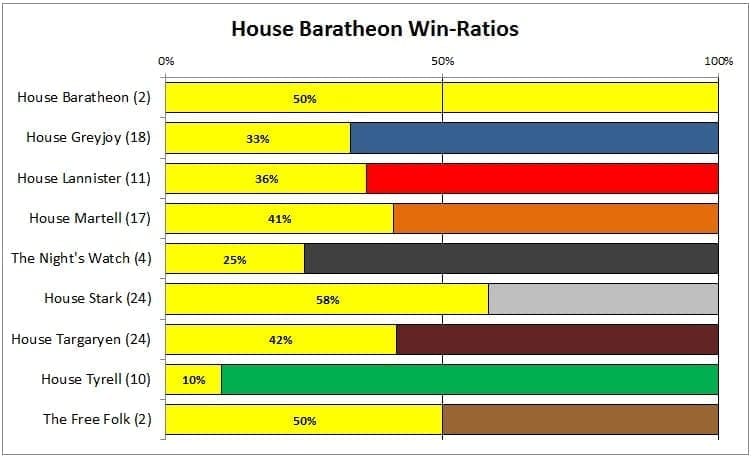
As with the Worlds stats, Baratheon represent the faction we have the smallest amount of data to look at. However, there is more to look at than there was at Worlds, and a couple of things stick out. Firstly, the Stark and Targ values have both trended down since Worlds. This likely represents a larger sample size meaning that the heroic exploits of a couple of Bara loyalists aren’t such a huge factor in the data. Secondly, the numbers overall are mostly worse than they were at Worlds. And lastly, blimey does that Tyrell stat not look, well, rosy for Bara. 10 games is not too many as samples go, but it’s enough that a 1-9 record is seriously poor. It seems like Bara’s decks have a problem with all-out constructive opposition decks, which Tyrell tend to be. On the flip-side, their only positive win-ratio is against Stark, who often also have a more constructive dent to their playstyle, so who knows?
Greyjoy
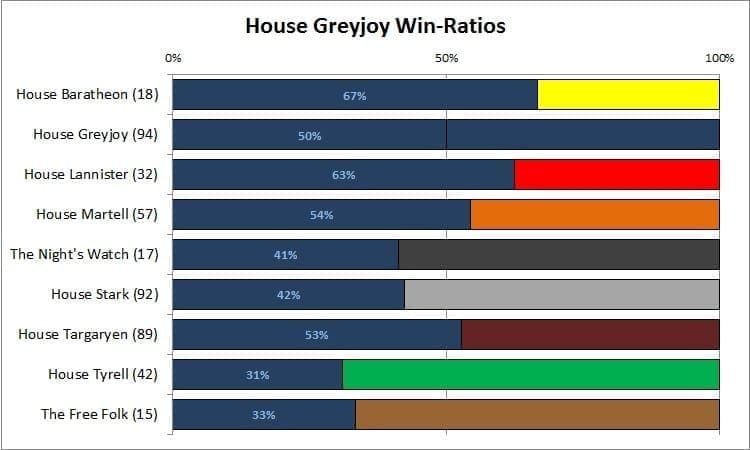
Compared to Worlds, the main thing that leaps out for Greyjoy’s stats is that, well, they’re less rubbish. Possibly after the faction were something of a damp squib in America, they weren’t as heavily built to counter? The main results that have significantly improved here are Martell and Targaryen. This would track with the idea of what did well at Worlds influencing Stahleck – Martell Wolf is not as strong a Greyjoy counter due to less focus on power grab than regular Martell and GJ broadly having a lack of good Ward targets, while House with the Red Door saw a huge upturn in popularity for Targ, and GJ can handle HRD pretty well between the Shipwright and Raiding the Bay of Ice.
Meanwhile, Stark has gotten slightly worse as a matchup, and Night’s Watch and Tyrell has gotten significantly so. In the former’s case, I think that’s just a case of Stark broadly doing better rather than a specific change in this matchup; in the latter’s, with only eight GJ Vs NW and only four GJ Vs Tyrell games occurring at Worlds, the most logical explanation is that the small sample size gave a false result, and that this is in fact a matchup that favours NW and Tyrell heavily. This would make sense, as you’d expect the faction with a strong focus on intrigue, power and STR pumps to stop easy triggers of A Pinch of Powder, and likewise the faction that focuses on defense. In the case of NW particularly there was also a change in decktype between Worlds and Stahleck – a lot of the NW decks at Worlds were built around Jon Snow voltron, while in Stahleck you either had Old Wall defence or New Wall attrition ruling the roost.
Lannister
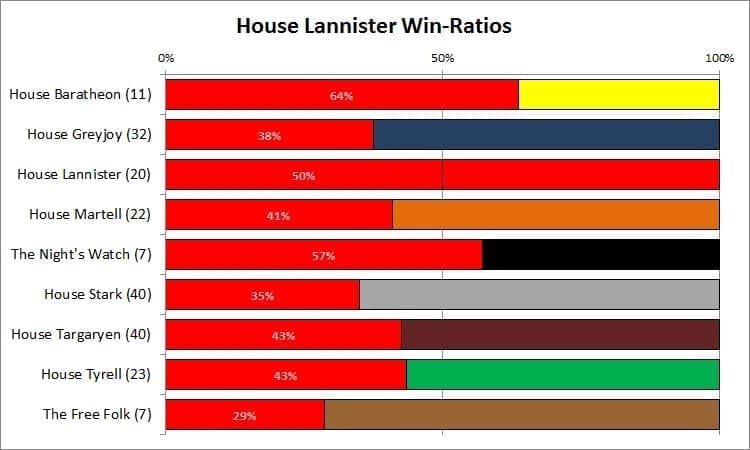
The results are in and *checks* Lannister aren’t too hot right now. Their only winning records were against the least-popular faction and the third-least-popular faction. Not only that, but their record against Stark has flipped almost exactly, from 4-2 at Worlds to 14-26 at Stahleck. With the top Lannister decks of the moment pushing attrition through Ilyn Payne, Catspaw and the like, it seems Stark are just too resistant, and that’s very bad news for those in the cloak of red.
Even beyond that we see poor results against Greyjoy and Targaryen, the other factions that are strongly represented. All-in-all Lannister need a big boost soon, it would seem.
Martell
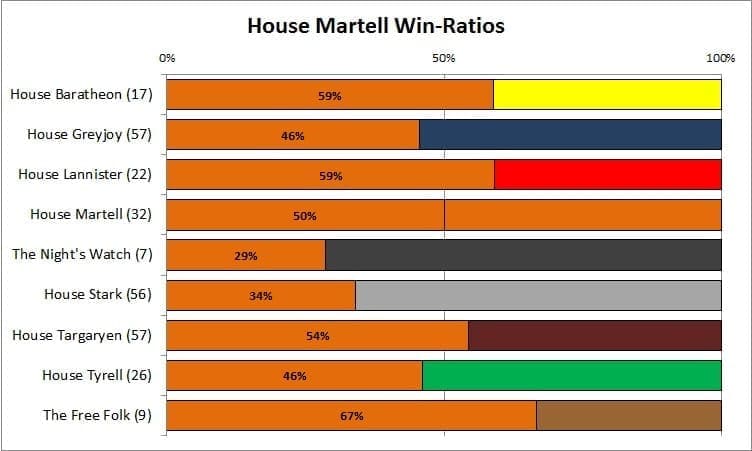
If one wants to see the problems Martell faced at Stahleck, one need only look at that Stark win ratio. Losing almost two-thirds to the most successful faction at the event is a surefire way for a faction to struggle. Additionally, their strong winning record against Greyjoy has flipped to being a negative one, and it’s a matchup they faced a disproportionately large amount given that Greyjoy’s presence was decidedly less than Stark’s and Targaryen’s. My only explanation for this is that, due to Martell’s overall lacklustre performance, they simply weren’t at the Stark/Targ-dominated top tables as much and thus were running into the Greyjoys that populated the X-2 and X-3 pairings. Their continuing positive record against Targaryen is at least something to celebrate.
The Night’s Watch
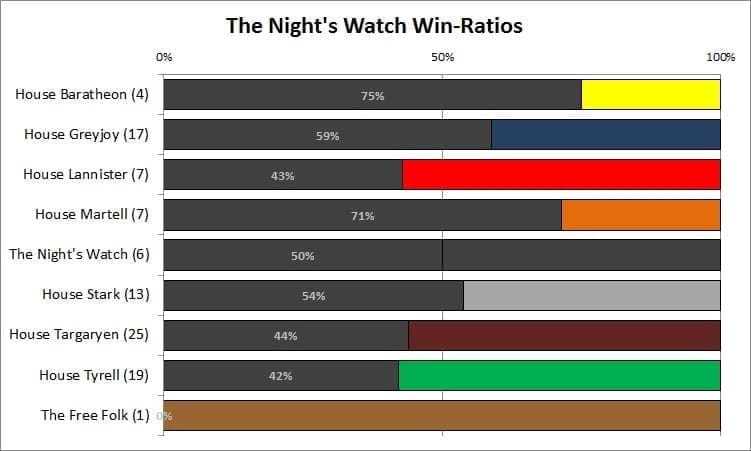
Night’s Watch were one of the less-fancied factions at Stahleck, resulting in comparatively few datapoints. The results they did record weren’t too disheartening, honestly – losing records to the fairly-irrelevant Lannister as well as Tyrell and Targ not ideal, but strong performances against Stark, Greyjoy and particularly Martell seem to bode quite well for the faction. Night’s Watch results remain arguably the least useful however, as this groups defensive decks, attrition decks and Jon Snow voltron decks under the unifying title of “Night’s Watch”.
Stark
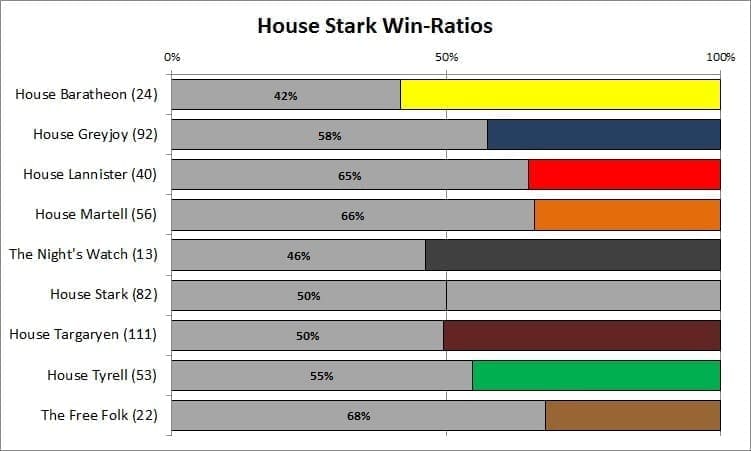
Stark were the big winners of Stahleck, and with those stats it’s not hard to see why. Going 50-50 with the next best-represented faction, having positive win records against the next most well-represented faction and the mid-tier factions as well, and only posting up losing records against Baratheon and Night’s Watch, both factions with a very miniscule presence at Stahleck. This is in, ahem, Stark contrast to Worlds where the faction had a reasonably heavy losing record to Targaryen. This matchup seems to be a key one in the current meta, and Stark’s ability to go toe-to-toe with Targ while broadly answering the rest of the field seems like a recipe for success.
Targaryen
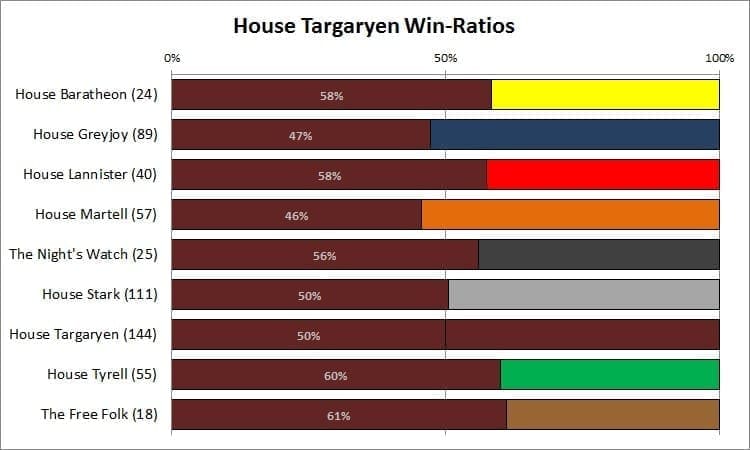
Targaryen’s stats are slightly curious. 50-50 with the other top faction? Check. Winning records against most of the other factions? Check. No truly terrible win/loss records against any faction? Check. Yet, after Worlds, these numbers are slightly underwhelming. The only explanation I can reasonably mustre is that with Targaryen drifting more towards the House with the Red Door agenda, they found themselves playing a deck easier to counter, strong though it is.
Tyrell
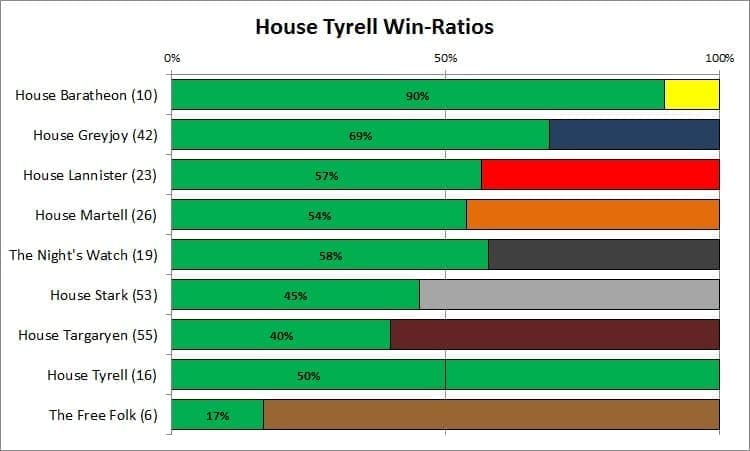
At Worlds, Tyrell looked in good shape except against Stark and Targ – but with Stark and Targ being the two largest forces in the meta, that was a problem. Here we kind of see the same story play out, but with significantly reduced downside – their 31% and 30% win records have improved to 45% and 40%. My hypothesis on the reasoning for this shift is that Stark and Targ focused more on countering each other than they did on the other factions. This resulted in the decks pushing slightly further away from being purely constructive, giving Tyrell some catch-up room (although they clearly still need work to improve). Against the other factions, Tyrell retain the same good/great results they did at Worlds.
The Free Folk
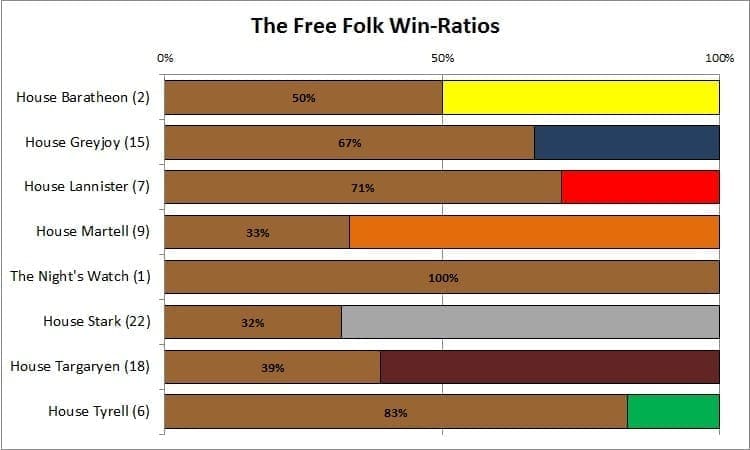
As with Worlds, The Free Folk was the only ‘faction’ not to play a mirror, so the data on it is missing.
Overall this data is of a small sample size, but throws up some curious results, most notably the big win against Greyjoy (Free Folk went 10-5) and the crushing losses to Stark and Targaryen. It’s these latter two stats that stop Free Folk from being a particularly relevant force in the meta, even if they do have heavily-positive win records against half of the factions. Overall between unimpressive performances back-to-back at Worlds and Stahleck, the days of fearing the deck’s potency already feel like they’ve waned.
And there we have the complete faction breakdown of Stahleck. As with Worlds, I have the data for agendas and faction/agenda-specific combinations so if you want to know any specific breakdown please let me know in the comments below and I’ll do my best to present them to you. Thanks for reading, and I’ll see you soon!