Hello Thrones Community,
Our journey through the Sea of Shadows cycle comes to an end with its sixth and final entry, No Crown But Truth. Alongside the shadowy and seasalt-stained cards seen elsewhere in the cycle, this last pack also shows interest in attachments and control-through-cancellation, as well as new tools for popular factional themes. An array of powerful cards have been kept until now, and we hope they will sustain you until our next cycle begins!

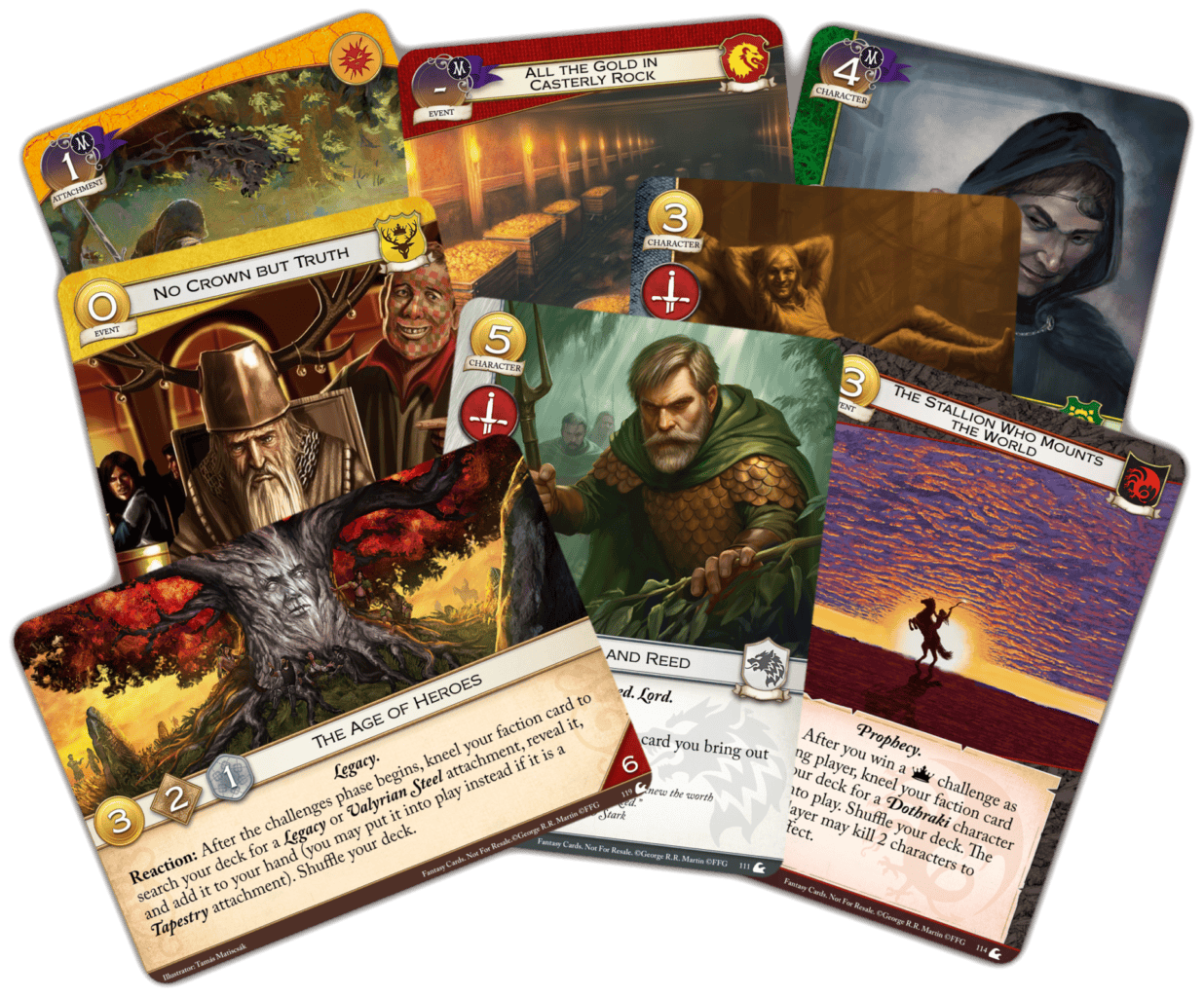
This chapter’s eponymous event comes to us from House Baratheon, with No Crown but Truth offering the cancellation of a character ability at the cost of a Maester’s life. The event combines its faction’s fondness for negation with cards like Healing Expertise, and takes inspiration from Maester Cressen’s desperate opposition to his king’s red witch. As such, while the Core Set’s Cressen offers some welcome attachment control, the variant added with Winter’s Kings pairs well for those wishing to feed cards to their agenda. We will see one such agenda shortly, but for now we have the Lady of R’hllor herself, Melisandre. Now boasting the shadow keyword alongside stealth, her mere presence weakens all participants without the shadow keyword. We hope for this to be the first step in providing the Lord of Light with the tools needed to burn His opponents, building on the faction’s theme of STR reduction and marrying it with its disunited range of shadow cards. In addition to bringing characters closer to the STR 3 threshold of Dark and Full of Terrors and facilitating cards like Banished from the Light or The Black Cells, this Melisandre variant also offers an in-built means of consigning a STR 1 character to shadows – with no token to help them escape!

Turning to House Greyjoy, their combining of “sea” and “shadows” has given new life to the Raider family of cards, looming out of the darkness to take The North unawares. This last location, Lonely Light, takes a different perspective – one more skeptical and wary of shadows, discouraging their use by its controller and defending from its use by opponents. Home to the isolated and self-reliant House Farwynd, the location offers a blanket increase in the shadow cost of all players cards for so long as it stands. This double-edged sword can foil old enemies like Lannister, Tyrell, and House Reed, but its distance from the mainland places it at odds with cards like Dagmer Cleftjaw or Torrhen’s Square. For more popular appeal, one can look to Shipborn Bastard, a cost-efficient provider of the Ironborn trait, a Power icon, and an initiative modifier. As one would expect of one born to the sea and without ties to land, this character is heavily reliant on cards like Salty Navigator, Refurbished Hulk, and the Kings of the Isles Silence variant.

If the ironmen provided this cycle with its “sea”, the westermen across the bay can be looked to for its “shadows”. This trend remains true to the end with House Lannister’s new event: All the Gold in Casterly Rock. With it, victory in an Intrigue challenge yields 2 gold for every card of yours in shadow, recouping any initial investment and providing a profit to those who employed alternative methods like Clever Feint or The Imp’s Agent. As an economic boost restricted to the challenges phase which rewards investment in the unseen, it is a quintessentially Lannister card. Less common in the faction is location control, but joining Pyromancer’s Cache is the Alchemist Apprentice; an in-faction alternative to the Pyromancers themselves, this cheaper neophyte takes the faction’s penchant for returning low-cost character to their owners hands and extends the threat to locations.

House Martell is infamous for subverting the standard modes of play, and the cards joining them in this pack are no different. The attachment Hidden in Shadow plays to the faction’s counter-intuitive strength of discarding its own cards from shadow, as seen with The Shadow City and The Red Viper from this cycle’s own Justice for Elia. Alternatively, the attachment can whisk its bearer – keyword or no – into shadows, a useful tool for recursion that can also help reduce Martell’s character count and play into their new preference for being outnumbered. Accompanying this card is Ser Manfrey Martell, castellan of Sunspear and subverter of keywords; where normally renown and insight reward winning participants with power and card draw, the participation of this Knight twists them into consolation prizes for the loser. Given this occurs regardless of who controls him, Ser Manfrey risks turning Martell’s fondness for failure into an aversion to victory.

Despite this pack’s interest in control, its contributions to the Night’s Watch eschew this favoured style of play to instead support less developed decks. Beginning with the Seventy-Nine Sentinels event, the faction’s Legacy of stalwart defence up to and beyond death gives players the ability to add any number of characters with one or fewer icons to a challenge as defenders. This style of deck has been resurgent in popularity following the release of Sentinel Stand in the previous cycle, and demonstrates how new support for disparate cards can yield entirely new decks. Another area of innovation comes with Wick Whittlestick and our ongoing merger of the shadow keyword with Jon Snow’s enemies within the Watch. Drawing inspiration from cards like Janos Slynt and the Bowen Marsh variant added in Ten Thousand Ships, the card’s emergence from shadow during an opposed attack against you forces a sacrifice on both sides. Through this self-destructive deterrence, we seek to evoke the divisions and betrayals wracking the Night’s Watch during its darkest hour.

Remaining with a divided North, “Wolves in the Hills” gives us a glimpse of House Stark’s role as peace-keepers among the northern mountain clans. This Song recalls Winterfell envoys sent into the wilds to rein in the bellicose hillmen and turn them towards their liege lord’s goals; appropriately, the event allows one to recall a Direwolf card from a successful attack to leverage an alternative type of claim. While naturally useful alongside locations like The Wolfswood and Winterfell Kennels, the event’s inclusion of Direwolf attachments in its criteria broadens its appeal and might encourage the use of those often-overlooked variants. While the northern mountain clans have not yet joined the faction’s roster, we can announce an even more significant debut: Howland Reed, the enigmatic Lord of Greywater Watch. Of the bannermen to whom Winterfell delegates engagement with shadows, none can match the aplomb of House Reed. Their patriarch reflects this by discounting the shadow cost of all Stark cards, from his own Meera Reed and Crannogmen to the Bolton Flayer and in-faction beneficiaries of The Wolf’s Den.

From division to unity, the Dothraki of House Targaryen can finally look to the khal of khals, whose khalasar shall cover the earth: The Stallion Who Mounts the World. While infamous for the devastating Military challenges, this event offers a more political perspective on horselords, leveraging a Power challenge to summon one of their own from the deck. This ancient Prophecy acts as an escalation from the likes of Overwhelming Numbers and Blood of my Blood by allowing them to remain in play afterwards – an effect of such significance that it demands some counterplay for its opponent, manifesting as the blood tithe of two killed characters. From a conquest that never was to an invasion yet to be, we have the fearsome War Elephants of the Golden Company, dispatched to crush those who might oppose Aegon Targaryen’s arrival in Westeros. As unruly beasts borne across stormy seas, this Army defies conventional deployment and is reliant instead on the ambush keyword to enter play. This cost is reduced for each Commander that has preceded them, but there can be merit in reserving the likes of Ser Harry Strickland in shadows so that one might bestow an Intrigue or Power icon upon one’s Elephant.

Next come those most likely to face Aegon when he at last makes landfall, the forces of House Tyrell. Continuing the theme of control and interplay between opponents, Growing Influence offers another cancellation event whose cost goes beyond mere gold – or rather, beyond the mere loss of gold. In keeping with the generosity of Highgarden, this one-cost event also requires the gifting of an additional gold to the opponent whose character or location was targeted. The Tyrells are known for being under-handed as well as open-handed, with Undercity Spymaster acting as a simple-yet-effective addition to a faction steeped in shadows and Spy support. Moving easily through the Oldtown Undercity and at home among the likes of the Oldtown Informer and Shrewd Diplomat, this character’s humble innovation is the stealth keyword – rare, despite the faction’s subtlety, and a useful alternative to manipulating participation.

Last in this pack and cycle come the neutral participants in Westeros’ woes. As with the previous cycle’s final entry, Winter’s Kings, this sees us focus on the realm’s faith and culture, with the Elder Brother coming to us from The Seven and “Widow’s Ford” recalling the bloody Andal invasion. The former character recalls the protection born of monastic seclusion by boasting invulnerability – though not an immunity to leaving play – so long as your plot honours his seven gods. The latter, a Song of shadow to compliment the last cycle’s “A Thousand Eyes, And One”, offers some security to a particularly crucial attachment or location; should it leave play, this event can secret them away into shadows before its glorious return.
The cycle’s final plot goes back further still, before the Andals and their seven-who-are-one, to the dawn of days and The Age of Heroes. This plot grants easier access to several specific types of attachment, and in doing so provides reliability to previously niche decks; alongside popular mainstays like Azor Ahai Reborn and Valyrian Steel Armor, less common beneficiaries Blood of the Viper or Blood of the First Men, Lady Forlorn or Nightfall, and – to once again call back to the Mists of Memory cycle – the plot is especially supportive of the new Tapestry family of cards. If one’s interest in attachments lies exclusively with the Weapon trait, however, look no further than the Armed to the Teeth agenda. In an effort to distinguish itself from peers like Valyrian Steel and Trading with Qohor, this new agenda borrows from The Conclave by building a curate armoury under one’s agenda. In addition to culling one’s deck and avoiding the need for repeated searches, this also encourages the use of otherwise-incongruous cards like Archmaester Marwyn or the host of Maester cards added in the last cycle – including Maester Cressen, as mentioned earlier.

In fact, returning to Cressen’s confrontation with the Lord of Light’s priestess may serve as a fitting segue to the cycle still to come. In addition to mechanical innovation, the upcoming cycle will look with new interest on the religions of Westeros; from wide-reaching The Seven, to the enduring Old Gods, and the nascent following of R’hllor, each faction can look forward to their own control-focused practitioner of the faith. These in-faction alternatives to the ever-popular Begging Brother can be seen as mechanical – and spiritual – continuations of Tapestry and Warship cards which characterised the previous two cycles.
Players can also look forward to more outnumbered support for Martell, more dominance support for Lannister, and much and more besides as each faction’s new mechanical theme continues to receive expansion. We hope this new cycle, entitled Old and the New, proves as fun and thought-provoking as Mists of Memory and Sea of Shadows.
Until then, we wish you good fortune in the games to come!
