The Mother was merciful, all the septons agreed, but the Seven had no power beyond the Wall. This was where the old gods ruled, the nameless gods of the trees and the wolves and the snows. “Mercy,” he whispered then, to whatever might be listening, old gods or new, or demons too, “oh, mercy, mercy me, mercy me.”
Hello Thrones Community,
Faith, religions, and the gods behind them are the first and most intriguing connotations carried by the Old and the New cycle. We have striven to do such concepts justice in its second entry: Whatever Gods You Keep. Much like the preceding Sea of Shadows cycle, each faction now receives its own non-unique entry; eight characters, designed to employ factional mechanics while demonstrating the many permutations of faith in Westeros. Although not united by a single Trait like Warship, these faithful characters align instead on the great benefit offered by their various religions: control. Most relevantly, mechanical control, manifesting throughout this pack as an interest in restriction, deterrence, and removal.

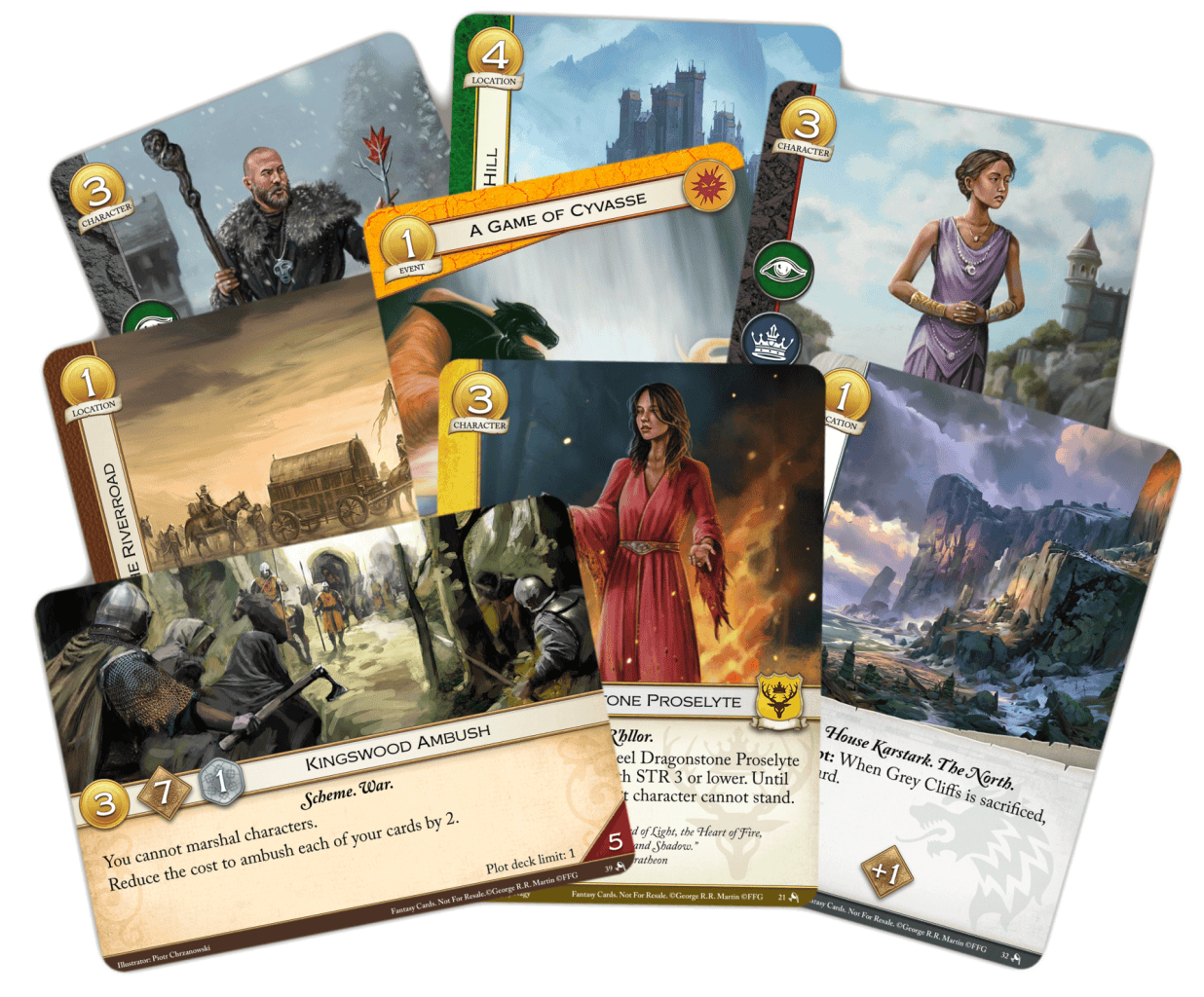
New to Westeros but old as humanity’s first flame, the faith of R’hllor is the only appropriate choice for House Baratheon’s entry. By kneeling his servant, Dragonstone Proselyte, one can prevent any character with STR 3 or less from standing that round, with such negation positioning her well among Dragonstone Castle, Dragonstone Convert, and Dragonstone itself, among many others. Remaining with the Red God, Fiery Talons continues the theme of banishing characters to shadows. Debuting with Daggers in the Dark, last cycle’s Melisandre variant saw the mechanical family join with Baratheon’s long history of STR reduction. This event takes that union one step further, complementing -1 STR with a terminal shadow banishment for those reduced to 0 this phase. The effect itself, its restriction to challenge participants, and its character-kneeling cost invite comparisons with House Targaryen’s iconic Dracarys!, but ultimately one’s preference between death and banishment will likely depend on playstyle.

For example, many who prefer death number among the Drowned God of House Greyjoy, the other faith to receive only one adherent this pack. As with all these non-unique faithfuls, Priest at the Docks strives to balance relevancy to both its religion and faction. While winning dominance and killing himself naturally places him alongside the likes of Core Aeron Damphair, Nagga’s Ribs, and Drowned God’s Apostle, we hope his targeted removal of attachments and locations can help him appeal where his fellows might not. Accompanying him, and continuing this theme of location control, is Deepwood Motte‘s second variant. Reacting to the kneeling of locations instead of prompting them, this instance rewards your use of assault with the standing of Asha Greyjoy or any Raider. Given its connection to Asha’s conquest of The North, her own Fleet from Ten Towers is an appropriate initiator, but more fearsome beneficiaries might be those bearing both the relevant Trait and keyword: The Iron Fleet, Orkmont Elite, Dagmer Cleftjaw via Foamdrinker, and perhaps more to come…

Our third faithful character comes to us from the tumultuous relationship between House Lannister and The Seven. Like The Red Keep looming above him and the Alchemist’s Guildhall lurking below, King’s Landing Septon undermines an opponent’s trust in their own cards through the threat of effect cancellation. Just as the Seven are One, his potential negation of any single character, location, or attachment erodes confidence in them all. Away in The Westerlands, midway between claim increase and hand control, we find Hornvale. Additional hand reduction through Intrigue victory immediately recalls Core Cersei Lannister, or perhaps her new Jewelled Diadem, given it can trigger even on defence. However, it is the opponent who chooses which cards are lost, and said cards are placed beneath the location instead of the discard pile, facedown to protect information. Gentler than claim increase, bypassing either side’s reactions to card discard, while denying you knowledge and them recursion, House Brax’s seat seems as unique as their sigil. Despite their differences, both Lannister cards bring with them the agony of choice.

From the heights of Aegon’s Hill to the shadows of Dorne, House Martell offers a humbler and more insidious iteration of The Seven. The faction’s revisiting of dominance loss continues with Shadow City Septon, whose indirect style of control mirrors his Crownland cousin. By forcing the dominant opponent to return a standing character to their hand, they subtler influence the determining of dominance through deterrence, only forcing a more frustrating choice if said deterrence is defied. And, by retreating to shadows, he not only primes himself for recursion but also offers himself as fuel for The Shadow City itself or more recent additions like Justice for Elia’s The Red Viper. A harsher choice comes with A Game of Cyvasse: each player is restricted to a single participant during your next Intrigue challenge, with your success promising a similar challenge will soon follow. Though supposedly even-handed in its restriction, few factions are better equipped to manipulate lone combatants; with the last pack’s Nymella Toland, the more seasoned War Scorpion, or the original, perennial Areo Hotah, one must be careful with Prince Doran’s Game.

Before Nymeria, or Aegon, or the Faith of the Seven, there was the Night’s Watch – and the Old Gods. Already hailing from a faction defined by restriction and obstruction, Superstitious Steward is free to employ a more situational style of board control, one reliant on correctly predicting the Trait of an opponent’s plot card. Indeed, his faction’s mastery of control can be seen in The Crow is a Tricksy Bird’s unique ability to dictate what that plot might be, although “The Rains of Castemere” and Battle of the Trident can help one guess while also moving his trigger from the plot phase. Unlike the other seven faithful, he alone boasts a second tribe of characters, and being a Steward of the Watch opens many avenues. While more segregated than other factions, we nonetheless hope he might even serve alongside a Builder, a Ranger, or both. Though still rare, the fielding of all three orders has been steadily encouraged, growing from niche incentives like Westwatch-by-the-Bridge to the flexible and dynamic Legacy of the Watch. Offered now is For All the Nights to Come, whose strict requirements come with an otherwise free boost of three power.

Remaining with Westeros’ oldest faith, this pack lets us not only expand the Old Gods family, but factionalise it. With Intrigue and sacrifice as common factors, this pack, Weirwood Grove, and The Black Gate demonstrate how the Watch’s faith focuses on Traits and prediction; conversely, the more aggressive Starks favour Bran Stark’s most recent variant, Taste the Blood, and even the Godswood from before the themes coalescence. The Woods Witch continues this, not only by acting as a low-cost non-unique trigger for each of these tribemates, but by leveraging the discarding of a character from one’s hand – such as through Intrigue claim – into a forced sacrifice of any card of equal cost. She herself must be sacrificed for this, in a show of apparent fairness reminiscent of The North Remembers or Rickard Karstark; indeed, House Karstark’s ready engagement with self-inflicted suffering has seen them turn such sacrifices to their advantage almost Dornishly. Following Arnolf Karstark‘s debut last pack, we now offer Grey Cliffs as an ideal candidate for his effect, offering a small initiative boost until it yields you a card.

A clear example of religion’s capacity for control is Daenerys Targaryen’s pact with the gods of Old Ghis – negotiated through their Grace interlocutors. The peace and painful compromises this pact secured have inspired the sisterhood’s recent additions, discouraging or preventing death and Military claims while facilitating Targaryen Intrigue. But unlike her kaleidoscopic counterparts, the Purple Grace intervenes directly in a challenge by reducing the STR of Military attackers. This quintessentially Targaryen mechanic can prove lethal, but her inability to target defenders prevents one from breaking the letter of Daenerys’ promise. To break the spirit of it, however, one might pair the faction’s many Military icons with claim replacement. The Temple of the Graces is a recent example, but By Sword or By Guile allows both Military and Intrigue challenges to yield a Power claim. Its title comes from Jon Connington’s threat to Storm’s End, which is only appropriate given their shared interest in twisting other challenges into struggles for power; although, as the sentiment easily applies to Daenerys’ duplicitous victories throughout Slaver’s Bay, both Army and Dragon attackers satisfy its requirements.

As the continent’s dominant religion and its repeated kingmakers, respectively, the Holy Faith and House Tyrell each have understandable interests in power. The former seems to find it distasteful, punishing its presence on the uninitiated and expending it as fuel; the latter are replete with it, through renown, lone participation, high STR victories, or otherwise. Rather than compromise like Highgarden Sept, Tyrell’s new faithful bows to doctrine: the Starry Septa levies the faction favourite stand-and-remove mechanic against characters bearing power – or gold, another vice The High Sparrow and his ascetic fellows condemn. Hypocrisy aside, this new faithful’s potential targets multiply further still when combined with The Starry Sept, Unbridled Generosity, or other poisoned gifts. This septa is even the seventh card in her faction to bear The Seven. A coincidence? Assuredly, but auspicious all the same. For other auspicious starts, look to the eager House Tarly and their home’s new variant: Horn Hill, which boosts your initiative and – during your first challenge each phase – your claim as well. This prize of The Reach can heed its liege and be conjured by Jade Sea’s Randyll Tarly, or otherwise the Stronghold has a cost deserving of For the Realm.
Our frequent discussions of control now culminates in the neutral additions, three of whom offer means of defying imposed restrictions, while the fourth dares you to defy its grip. Theodan the True, new Commander of the Warrior’s Sons, is a far more flexible foe than his rigid piety might imply. By repeatedly granting your choice of renown or insight to himself or another of The Seven, this Knight can accelerate victory or supplement a paltry hand – perhaps breaking an opponent’s attempt at slowing or choking you. However, for all the help he might offer, Ser Theodan must first win his challenges – helped, perhaps, by The Riverroad. The scenic route from Casterly Rock to the Vale of Arryn, this location transcends faction and tribe and simply provides any icon to any character. This single-use effect virtually guarantees someone the opportunity to at least declare participation, while also offering a small economic boost, or potential fodder for The Trident.

But neither plentiful hands nor location-based versatility win games in themselves, and renown does little for characters who have been banished to shadow, returned to hand, sacrificed, or discarded from play. When faced with such stringent board control, or if one simply wishes to assess the field before deploying, Kingswood Ambush can prove invaluable. Reducing each ambush cost by 2 most clearly appeals to the Clansman behind the eponymous battle, but this plot can aid Spy and Army alike; it need not even be limited to characters, with Venomous Blade, The Valyrian, and Lady Whiskers each benefiting from the discount. The cost is paid in other ways, however, as you are barred from marshaling your own characters – volunteering for a tighter restriction than your opponent could likely impose.

The danger when designing around control is discouraging engagement, punishing play in such a way that the only winning move is not to play at all. We hope the Sentinels of the Realm agenda offers something more engaging, incentivising attacks from your opponent by promising you card draw for each challenge type they withhold. The outcomes of these challenges are left to you and your opponent, a design choice capable of accommodating reckless aggression, strategic concessions, and all-out brawls. Again we see the agony of choice, but one where inaction fuels the agenda holder without simply handing them an inevitable victory. To help manage this balance of defence and counter-attacks, the agenda makes available all non-loyal Guard characters, while tempering this access with deck restrictions similar to those of Banner agendas or The Conclave. And to encourage direct interaction further, use of events are tied to the presence of a Guard, ensuring the board state remains populated and engaging.
We hope Old and the New’s second entry can bring some amicable tension to future games. Few things are as fun as a decent threat, so long as solutions are possible, if a bit uncomfortable. And for those interested in the faiths and card families expanded here, we wish you the best of luck, whatever gods you keep.
