Hello Thrones Community,
While the previous entry in the Sea of Shadows cycle served as a capstone to our nautical theme, players can still look forward to new interactions with the shadow keyword, hitherto unseen elements for the source material, and the development of new faction-spanning themes! All this and more comes in this penultimate chapter: Justice for Elia.

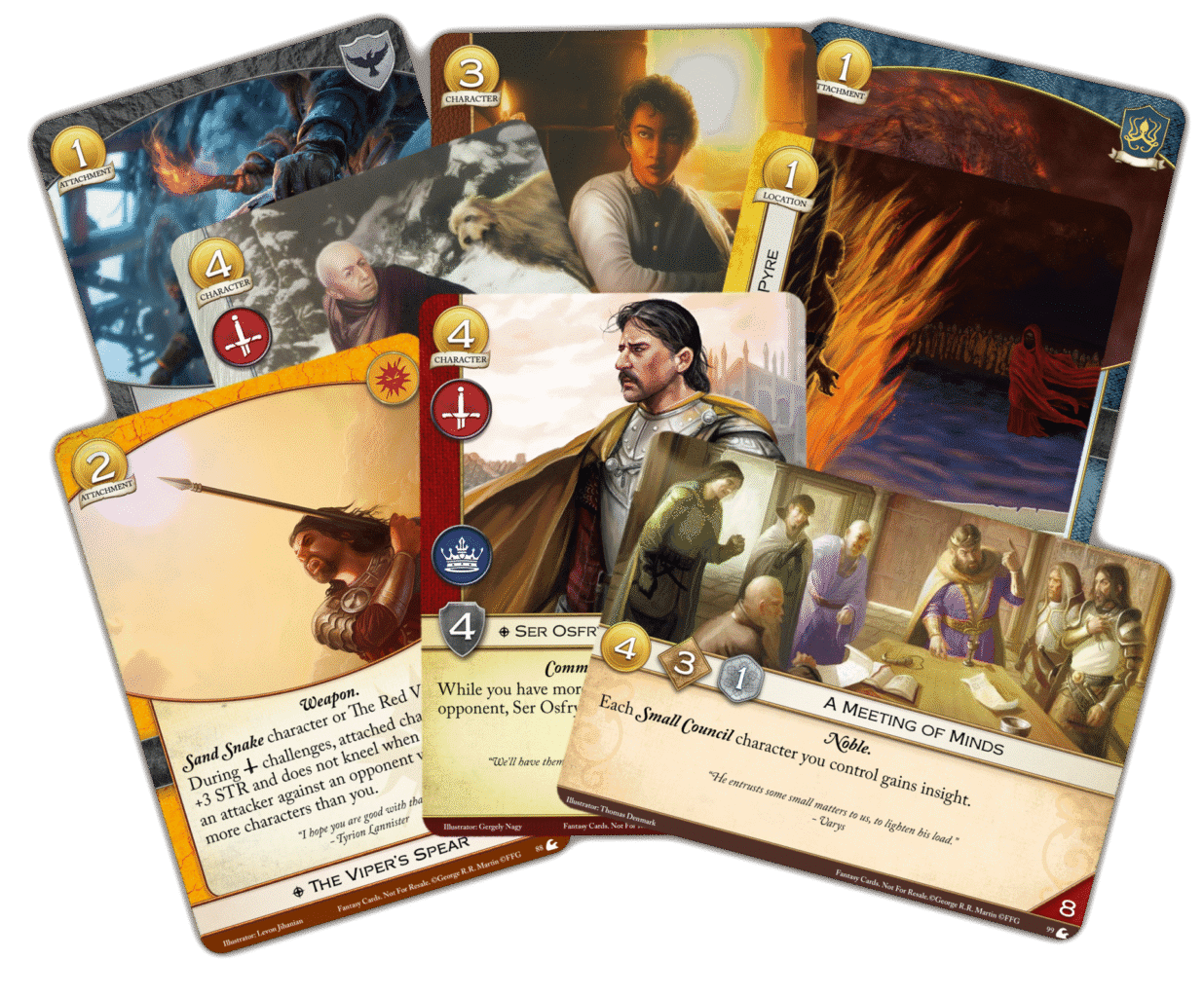
“Shadows are the servants of light,” claims Melisandre shortly before unleashing one of the strangest creatures seen in A Song of Ice and Fire: a Living Shadow. This insubstantial infiltrator and assassin may initially appear underwhelming, with no STR, no attachments, and no keywords beyond shadow and stealth. This is because its true strength – and mechanical innovation – lies in its capacity to latch onto those it bypasses using stealth, reforming into an attachment which declares the newly-attached character “cannot be saved”. In addition to the obvious vulnerability to Military claim, this death knell also prevents duplicates from negating banishing effects like Dark and Full of Terrors. Further helping this theme of shadow banishment – as well as the burgeoning theme of low STR punishment – is the Northern Pyre location, drawn from Stannis Baratheon’s campaign in The North. Leveraging the harsh and unyielding nature of the Winter family of plots, this location sets a participant’s STR to 3 for a single challenge; this effect can boost the weak, drag down the strong, or simply set someone up for the aforementioned event or kneeling from intimidation!

For House Greyjoy, we have a more character-focused selection, specifically the character of Theon Greyjoy. This variant of Winterfell’s unluckiest prince returns to us from this game’s first edition, depicting his time spent as a hostage of the Starks. Originally designed by Stefano Montanari, the two forced reactions communicate the lack of agency felt by Theon during this time; his political value can be seen in the power granted to each opponent should he somehow leave play, while the collection of income demanding the killing of one’s own characters evokes the tempering of Balon Greyjoy’s cruelty by Eddard Stark’s influence. The accompanying card – Smiler, Greyjoy’s first Warhorse – comes from a point later in Theon’s narrative, wherein he intends to embody his faction’s aggressive and predator ideals. Accordingly, the attachment plays to the perennial mechanic of unopposed challenges by rewarding such an attacker with either renown or intimidate, an effect which compliments the older variants of its master.

After defying precedent in the last three packs, House Lannister is content to add new faces to familiar mechanics with Ser Osfryd Kettleblack. In comparison to his brother Ser Osmund Kettleblack of the Kingsguard, this Commander of the City Watch has a simple-yet-desirable effect of gaining renown while your hand size exceeds that of an opponent. This conditional renown places him alongside Ser Amory Lorch and the Core Set’s Ser Jaime Lannister, but perhaps more valuable is the support he offers the Battle of the Trident agenda. If one is looking for more innovative interactions for characters with power, the new attachment Slander and Lies offers a precarious form of economy; once attached to an opposing character, you can spend power on them as though it were two gold from your pool. Beware, however, of the dangerous incentive you give to those you target as this well is fuelled by the mandatory awarding of power to the attached character each time they win a challenge against you…

House Martell offers another character-focused pair of cards, as well as the indirect namesake for this chapter, with The Red Viper. As with Theon earlier, this variant of Oberyn Martell depicts him in a context not seen before, that being the shrewd – but deadly – envoy of his brother to the Small Council. This subtler iteration eschews the renown and intimidate of its predecessors for stealth and shadow, while his ability to discard a card from shadow to raise your plot card’s claim assuring us that he remains Martell’s deadliest agent. Supporting him in this – and his faction in its exploration of new mechanics – is The Viper’s Spear, a Weapon exclusive to him and his Sand Snake brood. Boosting its bearer’s STR during Military challenges, the spear also demonstrates the faction’s theme of thriving while outnumbered; specifically, while a defender controls more characters than yourself, the attached attack does not kneel. Beyond the many benefits this offers past instances of The Red Viper, two others are its capacity to allow this newest variant to remain standing for The Small Council agenda as well as begin a bridge between the outnumbered theme and the Sand Snakes family of cards.

As both “the sword in the darkness” and “the light that brings the dawn”, the Night’s Watch can understandably have a complicated relationship with the shadow keyword. Recently, shadow cards have been associated with traitors and deserters, with the usurping Bowen Marsh of Ten Thousand Ships serving as their lynchpin. While this makes for distasteful company, Greyguard Artisan fits in wonderfully by emerging from shadows to replicate the text removal of Marsh’s Conspirator, but applying it to attachments as a Builder is wont to do. Paired with him is a more noble – and potentially debilitating – attachment, Torch and Oil, which not only shines a light on card’s marshaled into shadow by also those drawn from the deck. In both cases, the Item can be knelt to reveal the targeted card and – if it is a character – discard it. The attached character is then rewarded for their vigilance with a stand effect, making them ready again to defend the realm!

For all the family’s tragic losses, both additions to House Stark comes to us from champions, one returning from first edition and the other newly-minted to rejuvenate established decks. The former is Northern Patriarch, coming to us from Derek Shoemaker and honouring the memory of his grandfather. A truly fearsome non-unique Lord, its immunity to opponents’ Omen plots is merely a preamble to its potentially tide-turning triggered ability which threatens to cancel an opponent’s event unless they move one of their power to him. Fortunately, multiple copies of the character cannot each extract this potent toll. From more recent tournaments we have David Kennedy and the Winterfell Kennels, a new lynchpin location for the Direwolf family of cards. In addition to granting +1 STR to characters of this tribe, the location also allows you to jump a Direwolf card – character or attachment – into play during the challenges phase, before whisking them away to the bottom of your deck. While suitable in a variety of decks, the price and potency of this location makes it ideal for The House With The Red Door agenda, potentially challenging the proven partnership of The Wolfswood and The Many-Faced God.

Speaking of life and death and the colour of weirwoods, we have the additions to House Targaryen. Both hailing from Meereen, we first have a new entry in the Grace card family with White Graces, each a noble-born Lady whose service sees them accompany the likes of Galazare Galarre and Daenerys Targaryen. This service manifests in a similar manner to House Tyrell’s Lady-in-Waiting, as discarding them from hand or deck allows them to return as a duplicate for a unique Grace or Lady character. But duplicates are useless against the most lethal mechanic of House Targaryen: burn. And lurking in the shadows of Daznak’s Pit are the Poisoned Locusts attachment, which takes this familiar effect and applies it to the iconic Meereenese Tokar; reducing the attached character’s STR by 1 for each of their attachments, they eventually waste away, although simply applying the lethal persistent effect at all can allow other STR reduction cards to finish the job.

For our final two faction cards, we see House Tyrell demonstrate the charm that has served them for centuries, as well as a reminder that they’re not just a pretty face. In Baelor Brightsmile, we have the defender of Oldtown and heir to House Hightower, leveraging longevity from his family’s love of the draw deck’s top card. A sufficiently decisive victory involving this character allows one to reveal that top card, then either return it or place it over Ser Baelor as a duplicate. In addition to top deck knowledge and the safe sifting of unwanted cards, access to multiple duplicates allows one to invest more confidently in this renown-sporting Knight, especially if paired with personal-power generating cards like the Title of his family, Beacon of the South. Next comes that tragic and mythic Enameled Green Armor, worn first by Renly Baratheon and – after his death – by Ser Garlan Tyrell, while posing as Renly’s wraith. A striking sight, be it in a tourney or its only battle, its wearer can sway the hearts of fighters and tides of battle by usurping a participating character’s STR so that it contributes to your side of the challenge.

While limited in scope and strength, we nonetheless strive to have a pack’s neutral cards intrigue or entertain those who include them. In Alleras the Sphinx, for example, we have an acolyte whose origins are as mysterious as their intentions, but their utility in decks like The Conclave is clear – with their trigger making them especially suited for use by House Martell. The humble Candle in the Dark has, by its flickering light, the capacity to negate two of this pack’s most supported keywords: not only is the attached character immune to stealth, but by kneeling this attachment they can cancel any card effect borne by a card with shadow.

Broadening our scope, we finish with the chapter’s two plots. First and simplest is A Meeting of the Minds, which grants insight to each of your Small Council characters. By providing temporary access to this most valuable of keywords, the plot depicts the flashes of understanding which comes to those in Westeros’ highest circles; the exposure of Jaime and Cersei’s incest, or Ser Kevan Lannister’s capacity to repair the realm – were it not for Varys. While certainly useful for the recent Small Council agenda, we hope the many Small Council characters introduced alongside it are made more appealing, regardless of the agenda chosen. Paired with this plot is one of the most iconic, significant, and cataclysmic moments in A Song of Ice and Fire’s history: The Doom of Valyria. Appropriately, this Omen plot is capable of devastating a game state, discarding almost every card from play and purging the shadow area. However, also depicted here is the Prophecy House Targaryen claims to have received on the eve of disaster which saw them give up everything to escape, represented here by an opponent sacrificing a sufficiently large hand to cancel these effects.
We hope Justice for Elia proves just as engaging as the chapters that preceded it, demonstrating the design philosophies that have guided us through this cycle. Only one more pack remains from the Sea of Shadows, and as we approach that final, distant shore we would encourage you to push the cards released so far to their limit and wring from them all the joy we sought to put into them!

As of now the card Candle In TheDark still doesn’t function properly on TIT 🙁
Sorry if that’s not the place to report bugs, I’m just unsure where to report it.
It’s a great card, I would love to use it, but it breaks the game and plots and Agendas stop working when its in play.
Can anyone fix it?