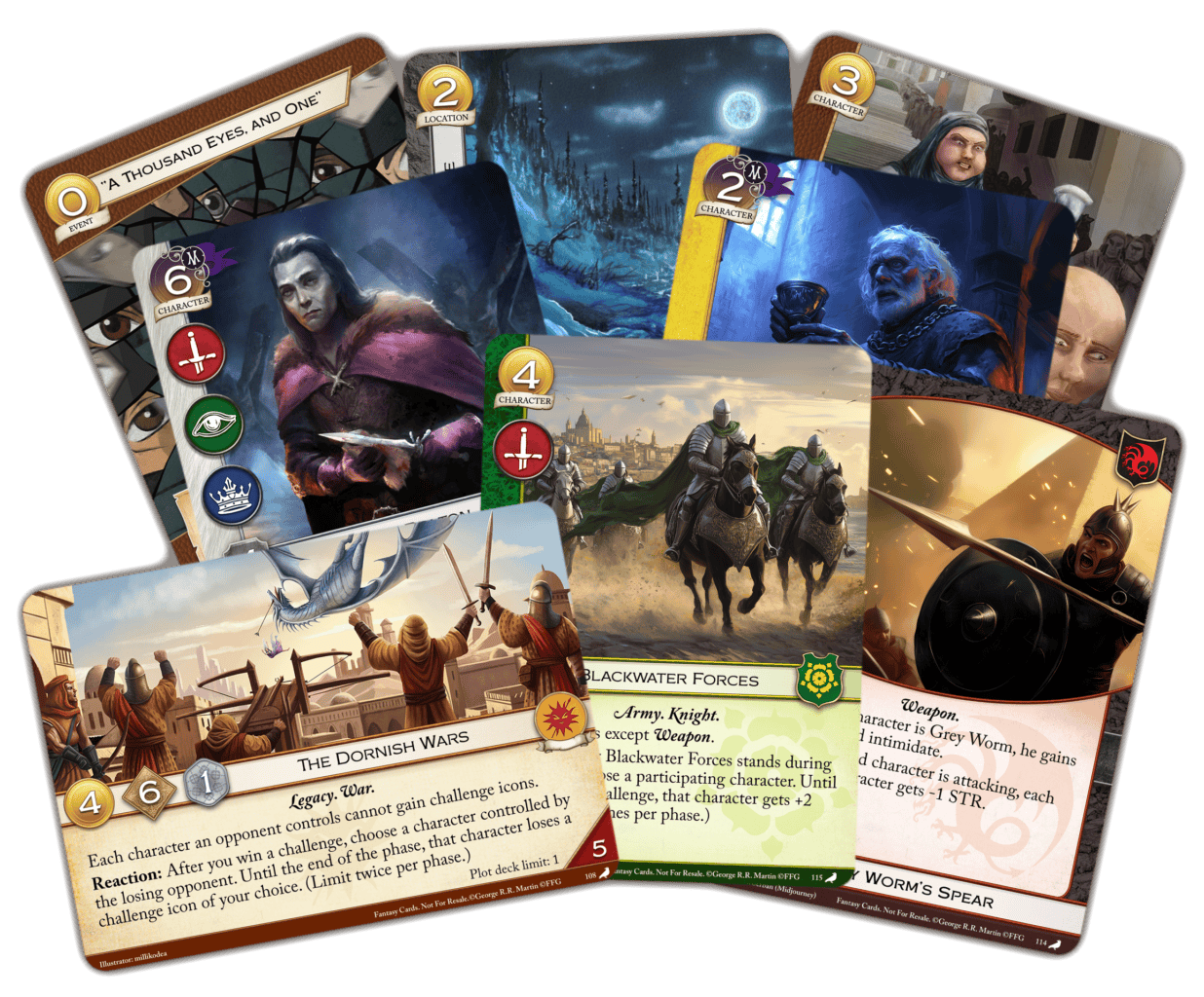
Now comes the final chapter in the Mists of Memory cycle: Winter’s Kings, the culmination of this most recent effort to innovate upon the familiar, mingling the ancient and the new, the established and the revolutionary. Featuring the most commissioned artwork of any pack released by the AGOT team, we hope you will agree that this pack’s contents are both engagingly designed but lovingly illustrated. Judge them for yourself upon release come the 2nd of October, 2024.

Few know the bitter taste of endings better than Maester Cressen, father figure to Stannis Baratheon and failed foe to Melisandre. A faithful servant of the Citadel, Cressen gave his life attempting to end the growing influence of R’hllor by trying – and failing – to poison the king’s red witch. House Baratheon’s new iteration of the character merges his duty to The Conclave, his attempts at duplicity, and his tragic death to give a character who conceals the top cards of your deck beneath your agenda when Cressen comes out of shadows – or when he enters your dead pile. Moving from the start of Stannis’ kingship to his most recent conquest, we have Deepwood Motte. The home of House Glover, this fortification was taken as part of the king’s campaign to seize The North and uses the revealing Winter plots to kneel any non-limited location.

House Greyjoy receives its own island-bound Maester in the form of Maester Joseran of Blacktyde. Mingling his faction’s preferences with mechanics useful to The Conclave, Joseran rewards winning initiative with moving the top card of each player’s deck under their agenda, denying an opponent their cards in much the same way he denied the love letters of Tris Botley be sent to Asha Greyjoy. Accompanying him is a location worthy of Winter’s Kings, Winterfell itself; specifically, a Contested variant of the location as it existed under Prince Theon Greyjoy’s brief occupation. And, just as Theon’s unexpected capture of the castle gave him Princes Bran and Rickon, so too does this reward an unopposed challenge with seizing control of a character controlled by the defender.

Moving on to those more proficient in subtlety, we have a new Spy for House Lannister: Tywin’s Whisperer. Much as its master favours striking a foe at their weakest moment, any time a low cost character is returned to an opponent’s hand is an opportunity to put this character into play – at which point it gains a Power icon and stealth for the duration of the phase. This character pairs well with events like Tywin’s Stratagem and “A Lion Still Has Claws”, but if a more deadly event is desired then players may prefer A Lannister’s Honor. Though perhaps oxymoronic, this event’s effectiveness cannot be denied as it forces a defender you defeat in an Intrigue challenge to choose and kill the weakest of their characters.

This chapter’s additions to House Martell thrive on loss in its many forms. The newest variant of Tyene Sand – now utilising her tutelage in The Seven – uses a loss at dominance to move power from the winner’s faction card to a character you control, exhibiting the preference for personal power seen with The Faith Militant, “The Song of the Seven”, and others. The faction’s new plot, The Dornish Wars, recalls the duplicity and defiance that preserved Dorne’s independence for centuries; not only does it prevent opponents’ characters from gaining icons, but it rewards each of your victories with the ability to remove what few challenge icons are still available to them.

The Night’s Watch are a faction familiar with the rationing of challenge icons. With this said, a character with no challenge icons is still a rarity, and when combined with a penalty to income and initiative one can see how Desperate Deserter is a hindrance to anyone unfortunate enough to control it. Fortunately, control of this living liability can be foisted onto an opponent simply by bringing a card out of shadows – and in doing so, the faction so fond of recruitment can finally give back to its opponents. But if the Watch cannot borrow characters, it will borrow plots – or at least their effects, through the Weirwood Grove. The site where followers of the Old Gods swear their oath of service mimics the revealed ability of any non-Omen plot an opponent reveals, working well with events like The Crow is a Tricksy Bird and the location’s Trait mate, Bloodraven.

In Roose Bolton we have a follower of old customs, if not Old Gods. This iteration of House Bolton’s patriarch demonstrates well how simultaneously alien and integral his family is to the Stark faction: their use of shadow and favouring of non-loyal characters sets them apart from most of their fellows, and yet his capacity to kill his own characters as readily as an opponent’s calls to mind The North Remembers, Wyman Manderly, and even Catelyn Stark herself. But before the Boltons ruled, there were the Starks, and not merely as Wardens… but as Winter’s Kings. And of these kings, the most fearsome was Bran the Breaker. By uniting the north against the Night’s King he began a Legacy which has endured through to Eddard’s time, teaching that the pack survives while the lone wolf dies. This lesson, preserved now as a Tapestry fit for any unique Stark location, encourages the use of multiple unique Stark character when attacking.

All this talk of blood and royalty naturally brings us to House Targaryen with Westeros’ newest King: the young Aegon Targaryen, named for the conqueror who reforged Winter’s Kings into Wardens of the North. This eager combatant’s unexpected landfall is represented here by his standing whenever a non-loyal Targaryen arrives during the challenges phase, making good use of the many cards that allow for the sudden arrival of reinforcements, from Jon Conningon, to Griffin’s Roost, to Our Word Is Good as Gold. Note that this stand effect is prompted by any non-loyal Targaryen’s arrival, friend or foe. Aegon is therefore well-prepared in case his aunt – Daenerys Targaryen – were to rally her own forces against him. And speaking of the Queen of Meereen, the Commander of her Unsullied now receives a Weapon worthy of him with Grey Worm’s Spear.

House Targaryen may claim “fire and blood” as their words, but those who braved the emerald hell wrought by Cersei’s alchemists at the Battle of the Blackwater know their meaning all too well. The Blackwater Forces fielded by House Tyrell are without fear and beyond weakness, strengthening a participating character when they stand amidst a challenge; this creates potential interactions with a wide range of cards, including Mace Tyrell (TSoW), Bonds of Chivalry, and Queen of the Seven Kingdoms. But House Tyrell have always thrived following fields of fire, be it Margaery’s marriage following the Blackwater or their family’s succession of House Gardner following Aegon’s Conquest. It is only through this usurpation that the Tyrells claim the home of their kingdom’s fertile forefather, Garth Greenhand. The lesson taught by this Tapestry’s effect is the value of a strong and growing family – and the value of gold, too.

Beyond the factions, we have new tools emerging from familiar mechanical families. For example, The Seven make use of personal power with Septa Unella, one of Cersei’s tormentors, whose participation blanks the text of any non-The Seven participant who dares hold personal power. This evokes The Starry Sept and also affords her interesting interactions with Lannister cards like Walk of Atonement, A Plot Against The Queen, and Ser Lancel Lannister. A old Song from the days of King Aerys the First, “A Thousand Eyes, And One” tells of the panopticon perpetuated by the mysterious Bloodraven during his time at King’s Landing. Fittingly, it lets one glimpse a foe’s hand or shadow area, then draws a card to replace itself. And to combat the many potent attachments added with this cycle – be they Tapestry, Valyrian Steel, or Cat – we have Burning the Books, depicting Baelor the Blessed’s purging of heretical texts which allows a player to pay power and force asceticism onto an opponent.

Lastly, in a cycle that has added so much variety to familiar factions, we have an agenda poised to utilise each of their strengths in a single deck: Uniting the Realm, through which any and all non-loyal attachments, characters, and locations can be woven into your deck. However, as any king would tell you, it is not easy keeping seven kingdoms in line. With favouritism forbidden, each faction can be represented by no more than three distinct cards.
And with that comes the winter of our cycle, the last entry in this last chapter, and the conclusion to the Mists of Memory. We hope the cards included here compel and intrigue you, offer new possibilities, and bring yet more joy to our wonderful community. But what comes next? What awaits us in the morrows not yet made? We cannot fully answer now, but we can leave you with the words of an old crow:
“Men live their lives trapped in an eternal present, between the mists of memory and the sea of shadow that is all we know of the days to come.“
– Brynden “Bloodraven” Rivers, A Dance with Dragons
