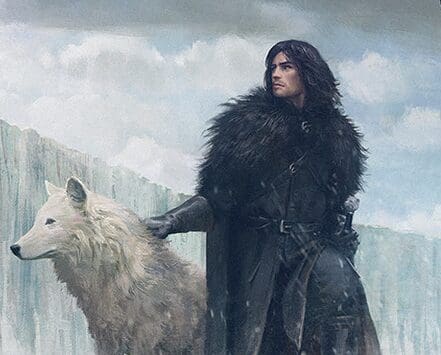
Hi everyone, today I’d like to take you all on a tour of my favorite deck archetype, known colloquially as Voltron. The term originates with Magic the Gathering but translates easily to Thrones. A Voltron deck’s primary strategy is focused around winning multiple high-leverage challenges with a single character. Usually this involves beefing up a specific character with attachments and/or other abilities. To accomplish this goal, the Voltron decks needs to meet several criteria:
- Find the chosen character quickly. There are several neutral search effects (most notably The Prince That Was Promised, The Prince Who Came Too Late, Heir to the Iron Throne, The Hollow Hill, and Summons) as well as a few faction-specific methods (Oathkeeper, Margaery Tyrell AMAF and Fresh Recruits) that help immensely. Regular old draw is also good.
- Win challenges with the character. Stealth and strength buffs are important here.
- Leverage those challenge wins with keywords (renown, intimidate, insight) and/or punishing abilities that trigger from winning challenges.
- Have a way for the character to participate in multiple challenges, whether via stand, non-kneeling, or other abilities that allow additional participation.
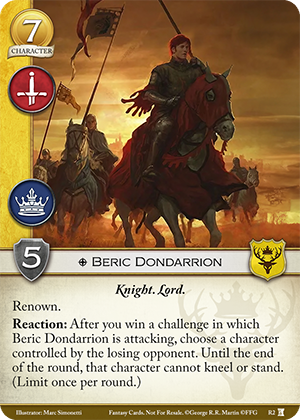
- Protect the character from negative attachments, removal, resets, and other counters. It needs to be resilient and stick to the board. Bodyguard and duplicates are the most common protection, but some characters like Victarion Greyjoy LoCR or Beric Dondarrion can save themselves. You also need enough military claim soak and cheap characters to prevent an unfortunate Marched to the Wall or Ramsay Snow.
- Have a backup plan if things go awry: either a second potential Voltron character, or an alternate win condition. When you put all of your eggs in one basket, metaphorically, things can and will go wrong sometimes! It can be difficult to invest card slots in a deck geared towards the backup plan without detracting from or impeding the primary goal. Ideally you can pair two win conditions that synergize together. A good example is the Night’s Watch deck that can Voltron Jon Snow WoTW and also defend The Wall.




Now let’s take a look, faction by faction, at both historic Voltrons and more recent developments. Hopefully this overview sparks discussion and leads a few more players to experiment with Voltron decks. There’s nothing quite like winning with 10 power and 7 attachments on your favorite character!
Neutral
Nearly any neutral character becomes a potential Voltron when paired with The Brotherhood Without Banners agenda, which adds a choice keyword for the entire challenges phase. Walder Frey has native renown and a means to participate in multiple challenges. Varamyr Sixskins can flex to meet your needs depending on the board state. Tormund Giantsbane comes with native intimidate and pseudo-renown. Rattleshirt becomes unblockable similar to Core Balon if you can clear any opposing attachments. Beric Dondarrion comes with excellent traits, renown, and protects himself from kill effects. Finally, Anguy the Archer is a cheap non-kneeler and a decent backup plan should your primary target fail.


There are plenty of neutral stand effects to help your voltron attack multiple times, including Seal of the Hand, Statue of Baelor, and The Prince that Was Promised. For protection, The Hand’s Judgment and Begging Brother are a good idea. Close Call offers a contingency plan in case of an untimely death. Attachment control is harder to come by, but there are a few options: old school Rattleshirt’s Raiders and Confiscation, or more recently Law Waste or Nothing Burns Like the Cold. In a sideboard/Rookery world, Beyond Reproach could even be worth a look.


It’s also worth mentioning several Voltron-friendly agendas. The Prince That Was Promised is tailor-made for building around a single character, with search to find the character, stand to re-use it in a second challenge, and even a contingency should the character die. There have been a few tier 1 or tier 1.5 Prince decks during the game’s later years, but it also allows for all kinds of wacky tier 2 builds, much like The House with the Red Door.

Trading with Qohor and Valyrian Steel are also excellent choices for Voltron builds, which naturally want to run a higher than average number of attachments anyways. Trading can make sure you have the right piece at the right time, whether that’s protection such as Bodyguard, stand such as Seal of the Hand, a strength buff to win the challenge, or an ability that punishes your opponent for losing. Valyrian Steel on the other hand takes more of a quantity over quality approach. Even marginal or incremental attachments become a lot better when they replace themselves, so it’s easy to load up your Voltron character with 5+ attachments that together create something stronger than the sum of its parts.


Baratheon
Baratheon isn’t the most prolific Voltron faction, but they have one monster of a target in good old Robert Baratheon. Intimidate, renown and a built-in strength buff make Robert a force to be reckoned with if he isn’t answered quickly. More recently, a cheaper and faster version of Robert Baratheon LMHR emerged and nearly landed on the restricted list (Selyse Baratheon took that hit instead). Both Bobs have the benefit of the King trait so they pair well with King in the North, Ser Davos Seaworth FotS, and Ser Justin Massey. Stannis Baratheon FotS, Ser Cortnay Penrose and the Bastard of Nightsong are decent backup targets should Robert be neutralized. There’s also Melisandre FotS who makes a fun Voltron when you’re trying to abuse A Pinch of Powder.


For positive attachments, Baratheon has a good mix of options that together meet most of our Voltron criteria: Lightbringer (stand), Disputed Claim (strength buff and renown), Warhammer (intimidate) and Red God’s Blessing (strength buff). At the higher end of the cost curve, Azor Ahai Reborn allows your Voltron character to participate in multiple challenges without kneeling, provided you can surround him or her with enough R’hllor characters.


Greyjoy
What first comes to mind when you think of second edition House Greyjoy themes? Is it the pillage keyword? The Drowned God trait? For me, it’s the obscene number of quality bomb characters that Greyjoy can field together. Right from the Core set, Asha Greyjoy, Balon Greyjoy and Euron Greyjoy rivaled Lannister for the best top-end lineup. Nowadays you could make an argument for almost any Greyjoy 6-drop or 7-drop as a voltron target. In some ways, the flexibility means they aren’t a true voltron faction. Even with the Prince agenda, if Greyjoy’s top option fails there’s little to no drop off in quality between the primary voltron target and the next bomb character.


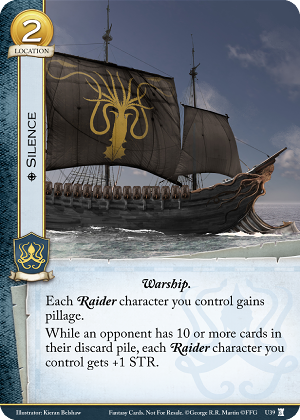
After the Greyjoy deluxe expansion, Victarion Greyjoy MoD and Euron Crow’s Eye KotI paired well together; both rely on Warships rather than attachments for support. There’s also a pillage module with Asha Greyjoy Km, Balon Greyjoy KotI, Euron Greyjoy and Gorold Goodbrother that can ride any of the bigs to victory. These decks aren’t necessarily voltron (maybe more goodstuff), but they can have elements of it, especially if you include Maiden’s Bane, Black Wind, Iron Victory, Silence, Great Kraken, Iron Fleet Scout, Support of Harlaw, Corsair’s Dirk, etc.




Lannister
House Lannister has three potential voltron targets worth mentioning briefly. First, Ser Gregor Clegane TKP becomes even more of a monster when given another icon with Noble Lineage and/or Little Bird. In addition to neutral stand options, a couple of Lannister events can either stand Gregor (Sparring in Secret) or allow him to attack without kneeling (There Are No Men Like Me). Ten strength, renown, and a punishing ability make Gregor a natural voltron candidate, but there’s something to be said for the RNG aspect of his ability leaving a bad taste in your mouth when it hits.


Secondly, there’s Cersei Lannister LoCR. Many decks have taken advantage of her non-kneeling ability and the obvious pairing with Casterly Rock, perhaps most famously the Wonder Woman archetype. Lannister doesn’t have many strong positive attachments beyond Widow’s Wail, so like the aforementioned Greyjoy decks you could debate whether Cersei is a true voltron or just a key character.


Finally, shout out to Ser Pounce, Myrcella Baratheon SoD and the Babies. Any sort of non-kneeling should always get the voltron wheels turning. In this case Qohor and Disputed Claim grant renown to greatly accelerate the win condition.


Martell
Martell’s voltron chapter starts and ends with The Red Viper. The most extreme version, known as Hyper Viper, used You Murdered Her Children LoCR and Crown of Golden Roses for massive strength pumps. Other buffing options include The Prince’s Plan, Dawn, Hotah’s Axe, The Mountain’s Skull, Doran Martell and Poisoned Dagger. It’s also easy to give the Viper renown or additional power with Bloodroyal, Secret Pact, or Sand Steed.


Night’s Watch
Jon Snow provided a glimpse of voltron potential, but his later versions were both significant improvements. Jon Snow WotW comes with stealth and a built-in stand ability that can be used on offense or defense. Jon Snow MoD is a Lord, with the host of benefits that keyword entails, and he can potentially have three keywords when surrounded with the right supporting cast of characters.


Dragon banners are frequently paired with the latter Jon to stand him back up. Queensguard especially works well when Jon has insight to draw a replacement card. In-faction stand options like Satin, Castle Black and Guard Duty help Jon participate in extra challenges too. All three versions benefit greatly from Longclaw and Lord Commander, as they lack native renown. Grenn also helps to accelerate the win condition by stealing up to two power. Halder and a few other attachments such as Miner’s Pick provide strength buffs so Jon can push through his challenges. Spare Boot protects him from negative attachments, and Dragonglass Dagger acts as a buffer against character abilities like Areo Hotah and keywords like Intimidate (but only while participating in a challenge).


Finally, if you’re not interested in Jon-tron, or if you just need a backup plan, there are several great options in the Night’s Watch faction. Haunted Forest Scout doesn’t kneel to attack and easily becomes a tri-con via Jaremny Rykker’s ability. Seasoned Woodsman loves to take attachments, especially in Valyrian Steel, while you wait for Jon to arrive on the scene. Craster’s immunity to Valar Morgulis and Valar Doaheris make him a reasonable place to stack power with Lord Commander in a pinch.


Stark
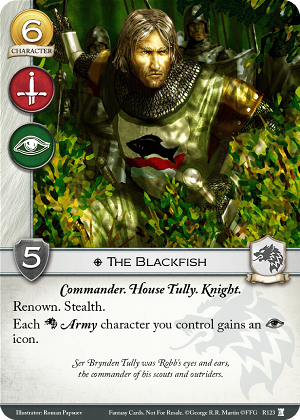
Given Stark’s affinity for Lords with renown, you might think they’d be a top tier voltron faction. Between The Blackfish’s non-kneeling potential, Eddard Stark’s constant standing, or “Fast Eddy” Eddard Stark WotN‘s power acceleration there must be something there, right? Actually the most significant voltron throughout 2nd edition has probably been “Fat Cat” Catelyn Stark WotN, and I would barely even qualify her a voltron anyways. Yes you want to protect Cat and take advantage of her ability, but you’re not usually dumping multiple attachments on her or even necessarily needing her to win challenges.


Stark does have an abundance of stand, including most notably Northern Armory and Robb Stark. They can also use Seal of the Hand on most characters, or in jankier decks there’s Favor of the Old Gods, Tower of the Hand and Jon Snow WotN. Stark Qohor or Valyrian have interest in Direwolf attachments such as Shaggydog MoD, Nymeria WotN and Lady, which are great on anyone attacking multiple times. Ice, Needle and Last Hearth provide some extra strength to push through challenges.


Ultimately, I would rate Stark fairly low on the voltron scale, maybe because their voltrons aren’t good relative to other faction’s, or maybe just because they’re not up to par with Stark’s own “good stuff” builds like Fealty and Crossing. They do have some of my favorite jank voltrons though, including Prince Catelyn Stark which is quite fun. Blood of the First Men and Summer WotW let her into military challenges so Cat can shut down any opposing threats or guarantee your own triggers going through.


Targaryen
Targaryen, on the other hand, boasts perhaps the best Voltron character in 2nd edition — Daenerys Targaryen DotE — and the right attachments to make her an unstoppable force on the battlefield. The original Daenerys Targaryen, along with her Hatchlings, made some noise in the past. But the newest Dany takes Voltron to the next level, with an ability to find an attachment or Hatchling once per round and put it into play for free. The recent pod restriction of Dany with Gifts for the Widow has put a damper on things however.


Targaryen is home to many stand effects for Dany, including Irri, Rhaegal, Mother of Dragons (pseudo-stand), Khaleesi, Mercenary Contract, Plaza of Pride, etc. In addition, they have methods of stacking power on her at an alarming rate, namely Jhiqui, as well as by giving Dany renown from Drogon, Dragon Skull, Silver Steed, or Warrior’s Braid. Tokar and Breaker of Chains pump Dany’s strength, oftentimes up to 15 or 20 points. Targ is also home to excellent attachment control including Viserys Targaryen and Shadow of the East, which are vital to clear away Milk of the Poppy, Craven or Hunting Accident. Finally, they have an excellent lieutenant in Khal Drogo who can take over, and a few other able voltron targets in a pinch, such as Daario Naharis or Ser Barristan Selmy LoCR. To summarize, Targaryen checks all of the Voltron boxes.


Tyrell
Right from the Core set release, Randyll Tarly’s pairing of stand and Renown together made him an obvious big hitter. After some time, however, Randyll ceded the throne to Renly Baratheon FFH, who has the advantage of all three icons (great for Crown of Golden Roses) and Insight in addition to Renown. The loss of stand for Renly is often addressed by pairing Tyrell with the Dragon banner for Queensguard, though Highgarden Courtier does the job cheaply in faction as well. It’s worth noting that he does come with an unfortunate aversion to opposing Kings, so you may have to Milk your own Renly temporarily in order to save him from Valar Morghulis.


On the cheaper side of the curve, Green-Apple Knight features in many decks as a non-kneeler who becomes a tricon with Noble Lineage and can often reach 6+ strength with the help of Jousting Pavilion or Arbor Marketplace. He won’t rack up power (until your Tourney for the King round), but he will win challenges with only a little investment. The last voltron target worth a mention is Brienne of Tarth HoT, an admittedly janky option, but so satisfying to pull off. The designers were too cautious with her ability, though the idea behind it is pretty cool.


The Rose Banner, like the aforementioned Dragon banner, is a frequent choice for supporting other Voltrons by including Oathkeeper, Highgarden Courtier, “Lord Renly’s Ride”, Honeywine, and Randyll Tarly.

First edition
Several changes between editions made Voltron decks more viable. The designers wanted important characters from the novels to be just as important in the card game. To that end, they allowed duplicates for free on setup, and also made attachments non-terminal by default. Now expensive, powerful uniques often feature at 3 copies each rather than the previous norm of 1x.
But even in 1st edition, with it’s less encouraging ruleset, there were several Voltrons worth mentioning. The most powerful was undoubtedly The Red Viper (Princes of the Sun), a non-kneeling tricon with renown AND built-in immunities — basically everything you could ask for in a voltron target. Other examples imclude Asha Greyjoy (Where Loyalty Lies), Stannis Baratheon (Valar Morghulis), and Cersei Lannister (Lions of the Rock). These characters demanded an immediate answer or they could take over the game.
Hopefully this article sparked some interest in my favorite style of play. Please comment if you enjoyed it or want to discuss!
