By way of disclaimer, I began playing AGOT during the Secrets of Oldtown cycle of 1E, three cycles after the original release of the mechanic, and as such, until 2E began, I had never played in an environment
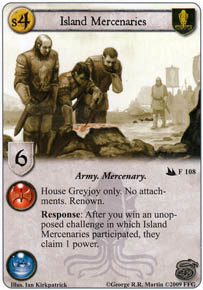
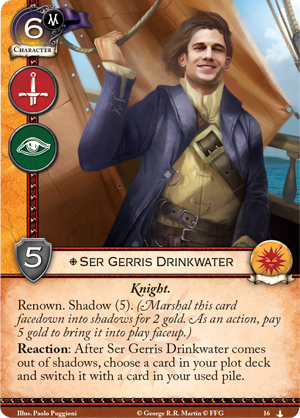
As a first step, it might be instructive to explore the differences in the mechanic itself from 1E to 2E, based on what was given in the introductory article. In First Edition, Shadow cards could be set up into shadows for 2g, and marshaled into shadows for 2g as well. Both of these facts remain true for Second Edition, although 2g doesn’t necessarily mean exactly the same thing across both editions. While this investment in 1E was ⅖ of your setup, it’s now only ¼ of it. However, with a few notable exceptions (a Littlefinger who cost 2+10 but whose cost was reduced by your opponent’s power total, and a cycle of enormous Mercenary armies who rarely saw play), the costs for bringing the cards out of shadows was also generally only 1-2 gold at most, whereas we have already been shown with Ser Gerris Drinkwater that we can expect the shadow costs in 2E to more closely resemble the current gold curve. This can be seen as somewhat of a nerf to the mechanic, as having an expensive “out of shadows” cost will require high gold counts, and prevent the use of reducers such as Great Hall and Kingsroad that often power the economy of many decks today. Consequently, high gold plots may be required for decks that rely heavily on the mechanic.

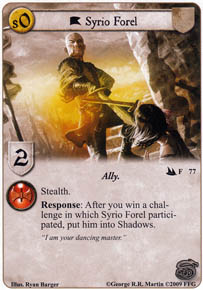
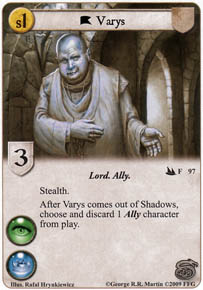
Another major change to the mechanic involves timing and mechanism of the cards themselves. In 1E, there was a framework action at the beginning of every phase, wherein each player could pay the “out of shadows” cost of one card and bring it out of shadows. This meant that cards with 0 “out of shadows” cost were naturally more versatile, as they could be brought out at the beginning of any phase, allowing you to win dominance with a character that your opponent might not have been expecting, or hide them from claim or challenge-phase kill effects. It will be interesting to see if we get similarly versatile shadows cards in 2E, but based on the cost discussion above, it frankly seems rather unlikely. The “Action:” timing of the new shadows mechanic, though, more than makes up for the lack of versatility due to costing- these cards are now true surprises, and can be brought into play at times that are even more beneficial than 0-cost Shadows cards in 1E were. They essentially dodge stealth from attackers, and since there is no once-per-phase restriction as the 1E rules gave in practice, multiple shadows characters can be used to blunt a reset such as Varys by staying hidden until the Standing phase when he’s already triggered.

The last change is not with Shadows, but with 2E itself: Reserve value. In 1E, Shadows cards were safe from intrigue claim, but in 2E, they are also not part of a player’s Reserve, which inherently increases their value. It’s interesting to me that the introductory article openly refers to the Shadows area as ‘a second hand,’ when this is one of the things that is brought up fairly often as a complaint. It does add another zone to the game, and thus adds complexity that some may see as unnecessary. I do think that statements such as “Shadows devalues the intrigue challenge” are a bit hyperbolic, because most decks clearly will not be made up of anywhere close to 50% Shadows cards, even after they are fully released, but it is fair to say that it does lower the impact of the Reserve mechanic to a degree.
One of the most common criticisms that I’ve seen about Shadows is along the lines of this question: “Why do we need both Ambush and Shadows in the game?” My off-the-cuff answer would be, “We probably don’t”- it is true that they often occupy the same design space. However, that doesn’t mean that this is a poor decision- after all, it’s not clear that Ambush is the better mechanic, just that it came first. If pressed, I’d contend that Shadows is the more interesting of the two mechanics, and if only one were to survive to be evergreen, it is the one I’d choose. However, this is clearly not the reality of the situation, and as we will have both going forward (at least for the span of a cycle, but hopefully longer), it’s a question worth asking. While the two are fairly similar on the surface, there are some key differences that make it worthwhile to introduce Shadows into an environment where Ambush already exists.
•Ambush is limited to the Challenges phase, whereas Shadows, as an Any Phase action, is significantly more versatile. A simple example is this: As it currently stands, if you end the challenge phase with only one large character on the board, there are precious few cards that will prevent that character from being Marched to The Wall during the next plot phase. With Shadows, however, you just might be able to save Tywin from joining the Watch (a fate worse than death, as we all know).

•Shadows allows for a more robust economic decision than ambush. Being able to pay 2g either during setup or marshaling, and potentially save that card across multiple turns until the exact moment that it is most needed is quite powerful- essentially, it can be seen as a means of ‘investing’ some gold in a future board state. It allows one to spread out the cost of a more expensive card such as Gerris, rather than having to find a way to acquire and then spend that gold all at once. Also, as shown by the spoiled event, Beneath the Bridge of Dream, it also allows for events to have a ‘cost’ to them, but still be triggered at times when a player would normally not have gold.
•The specific zones of play from which Ambush and Shadows occur is also an important distinction. First, there is the obvious matter of cards in Shadows being immune to intrigue claim and reserve. The debate about whether this is a positive or a negative is ultimately rather subjective, and depends on one’s personal tastes, but for my money it’s generally a plus. While I can see why someone learning the mechanic for the first time might believe that it has the potential to get out of hand and devalue the intrigue challenge completely, I am unconvinced that this will be the reality of the situation.
A further difference is that ambush cards (and non-Shadows events, which share some similarities for the purposes of this topic), by nature of coming directly from one’s hand, are vulnerable to targeted hand destruction cards such as Seen in Flames or His Viper Eyes. While you may go first and be able to use an ambush card before these trigger, it will certainly force the action, rather than allowing you to bring them into play at an opportune moment.


Additionally, and somewhat paradoxically, if you are not running cards such as Seen in Flames, a card in Shadows can be LESS mysterious than a card in your opponent’s hand. Cards in an opponent’s hand can be essentially any card allowed by his or her house and agenda combination, whereas the subset of possible Shadows cards will be significantly smaller. This allows for more skillful decisions, rather than situations where an opponent might not be able to “play around everything” simply because the variety of possible holdings is so high.
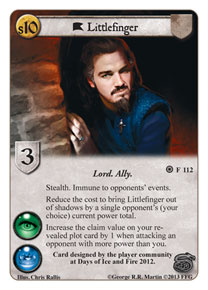
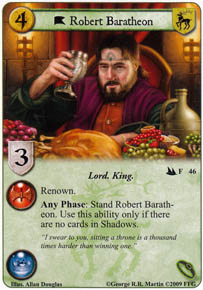
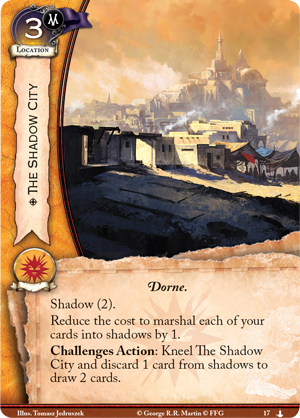
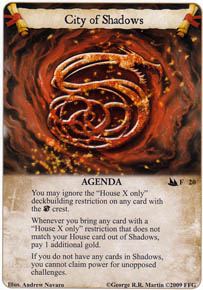
•Shadows itself is a new zone that can be interacted with in a number of unique ways. In 1E, in addition to the Shadows cards themselves, there were also several popular (if, in some cases, hopelessly overpowered) cards that referred to the zone. For example, this version of Robert Baratheon, with which Brett Zeiller won Worlds 2011, will only work if there are no cards in Shadows- often a risky proposition, but with big upside. As such, it’s reasonable to expect that this design space will be explored again, with triggers such as “While there are (x) cards in Shadows,” “While you control at least (y) cards in Shadows” and similar. It also allows for designs that specifically target Shadows cards, as we see in Shadow City.
•The timing of “comes out of shadows” allows for very precise triggering conditions, potentially. Beneath the Bridge of Dream, though imperfect since events often have unique triggers, is a decent example: Imagine if an effect like that were on a character, and said “Interrupt: When a plot would be revealed, bring X out of shadows to _____.” These are the sort of things that Shadows can do, but Ambush cannot.
- How many current Ambush cards would have worked better as Shadows effects?
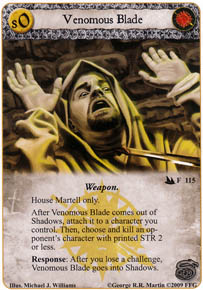
This is a fun question! The one that springs immediately to mind is one that was previously a Shadows card: Venomous Blade. In 1E, it also killed small characters as it does now, but it did so as a passive effect when it came out of shadows at the beginning of a phase. While the card was quite potent (indeed, it spent much of its legal life on the Restricted list due to its ability to recur itself), it also removes the fiddliness of the ‘poison token’ that the new one possesses. It’s possible that due to the changes in the rules, 2E VenBlade would look very similar as a Shadows card, but it’s possible to template it so it doesn’t. There are a few others that fit in this category for me, less for mechanical reasons and more for thematic reasons. The Queen’s Assassin is literally standing in a shadow, and while I understand the idea of him ‘setting an ambush’ for someone, it feels like he would do so in a very different way than, say, The Hound. Qaithe of the Shadows is another in this group for me, as it’s right there in her name. In general, it feels like there is little differentiation in the Ambush keyword between actual attackers such as the City Watch, and people who are more likely just doing sneaky things, such as the Dornish Spy.


- Is it another tool for negating stealth?

- Will Shadows increase or decrease the importance of challenges?

- How big was the mystery element in 1E? When you played a shadows card, did your opponent basically know which card it was based on your house and agenda, or were there enough options to keep them guessing?
- How long will it take for the mechanic to enable any genuinely surprising plays? Even if each house gets a shadow card in each pack (which seems unlikely), it seems like it will be a long wait before things get interesting.
I don’t want to speculate on a timeframe, because that depends quite a bit on how many total Shadows cards are released, and how they are distributed throughout the cycle. I will say, though, that the Banner mechanic makes it more likely that surprises will occur in 2E than it did in 1E. All non-neutral Shadows cards in 1E had the text “House X Only” on them, which was essentially the 1E version of “Loyal.” While we haven’t seen any examples yet, it’s reasonable to assume that not all Shadows cards in 2E will retain such loyalty, and so it naturally increases the possibilities for surprise from a given Shadows card.
- As somebody who’s (perhaps cautiously) optimistic about shadows, here’s my question/concern: how likely is it that the mechanic will be used to sneak in some powerful effects that would’ve have been printed another way? For reference, my understanding of Prized is that it essentially enabled some ‘broken’ or extremely powerful cards to be printed because they had a theoretical drawback that in practice was not hard to play around. Should I be worried shadows may end up enabling similar effects?
You are absolutely correct about the way that Prized played out, but I don’t think a comparison to Shadows is particularly fair. Shadows is more an alternate cost/marshaling, and less of a ‘theoretical drawback.’ There were some Shadows cards that could be considered over the curve, but there were also cards (see the Robert Baratheon mentioned above) that were broken and were anti-Shadows. There were only three Shadows cards that made it to the Restricted List; one was a Champ card, and one was released near the end of the game when the power level of ALL cards was being pushed. As usual, it’s likely that we will have to evaluate each card on its own merits.
- With shadows coming I think my biggest worry is how difficult will it make the game for new people. Because if the game doesn’t get new people it is only losing people.
While Shadows does add a new zone, I don’t think that it’s a mechanic that is particularly unintuitive or difficult to figure out. It certainly wasn’t the most complicated thing about 1E, and I daresay that there are already deck types (Builders or Combo) and rulings (Varys’s Riddle vs Summer Harvest) in 2E that will confuse or dishearten a new player more than “facedown for 2, faceup as an action for the Shadow cost.”


- I’m interested whether imbalances between the houses can/will be mitigated. – Will some houses get their cards earlier and benefit more (like with the 2cost economy locations last cycle)? – will every house get the same amount/quality of cards or is it likely shadows will become a subtheme of one faction/a few factions? – Finally: will it be fleshed out enough to be relevant?
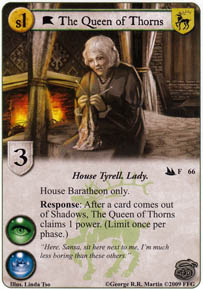
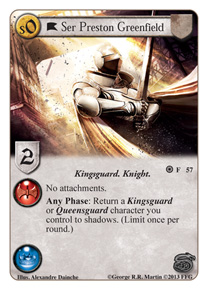
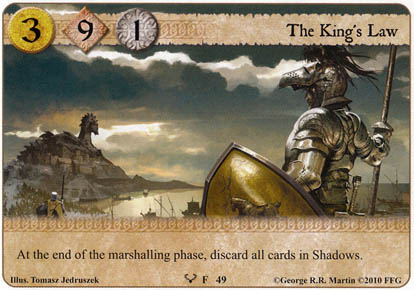
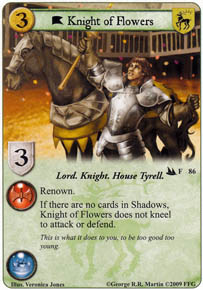
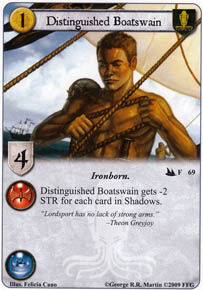
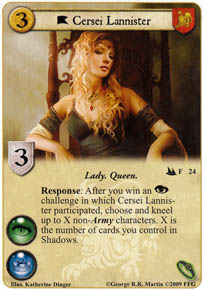
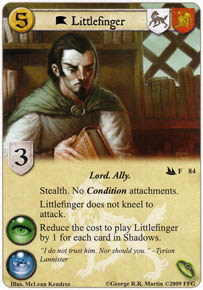
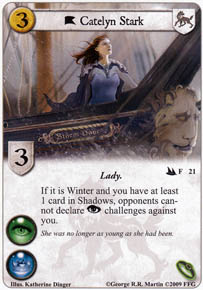
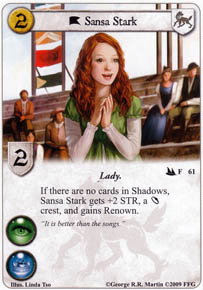
As above, there are some questions in here that probably can’t be answered until we see the full breadth of the card pool, or even speculated on until we see the full contents of the first couple of packs. However, we can look back at 1E for some examples of what might be done with each house thematically. In 1E, the six houses were often divided into sets of two when it came to giving out mechanics. Seasons is a good example: Greyjoy and Stark had cards that liked when it was Winter, Martell and Targaryen had cards that liked when it was Summer, and Baratheon and Lannister had a mix of both, or some that could switch back and forth. Shadows was divided less neatly, but generally speaking Baratheon and Greyjoy had a good amount of effects that either prevented Shadows or worked better when nobody was lurking in them: For example, The King’s Law, Knight of Flowers and Distinguished Boatswain. Lannister had many cards that enjoyed having Shadows cards, such as Cersei Lannister and Littlefinger. And Stark had some of each, from the same family no less: Catelyn Stark and Sansa Stark. That said, there were certainly powerful Shadows options for even the “anti-Shadows” houses, so everyone will get a chance to make use of the mechanic, and in some exciting and diverse ways. As for relevance, I expect that FFG will want to showcase such a mechanic enough that we will see the cards pretty regularly. It’s also important to note that based on the 2E model we’ve gotten so far, we will get twice as many chances at useful Shadows effects, as there was only one cycle initially that had Shadows in 1E, and then another that semi-featured it (along with some other returning mechanics) near the end of the game.
- Anything that makes the game more like 1.0 is worrisome to me because of how I am told the game was played…Decks were just full of board clears and the challenge phase was mostly irrelevant. Games were won and lost on the backs of 1-2 cost chumps. I bought into the game for the IP, less so the mechanics, so a world where nobody plays any of the Uniques is uninviting for me. It’s just a signpost that design is really just catering to what 1.0 players want and maybe making less-good decisions.
This seems to be a prevailing sentiment, and it is unfortunate that several of the commenters mentioned specifically that they were against Shadows expressly because the players who claimed that 1E was better near the beginning of 2E enjoyed the mechanic. It’s fine to dislike others’ opinions, or how the are presented, but I’m hoping that everyone is at least willing to judge 2E Shadows on its own merits once it is released, and not be colored by the (perhaps overly aggressive) opinions of those who remember it fondly from 1E.
With that out of the way, the description given for 1E is pretty overblown. It has been perpetrated throughout the community, and there were certainly times when it was more true than false, but to say that “1E was ____” (any given environment specifically) is unfair. The fallibility of duplicates (they did not have ‘cannot be canceled,’ though there were still not a huge amount of effects that did cancel them) did cause people to build their decks in different ways, with a wider variety of unique characters rather than the 3x Asha, 3x Euron, 3x Victarion that we see in today’s Greyjoy deck. But there are also other reasons for such deckbuilding differences: Setups were far less forgiving, the economy was different, diversity of theme, powerful agenda effects, etc. There were times when decks with lots of unique characters were very powerful, and times when they were less powerful. There were times when combo decks (Zeiller’s Maesters, the King Viserys Attachments deck) won the day, times when rush (Martell Maesters, Bara Noble Cause) was on top and times when a solidly-built midrange deck with the all-star characters from your house (Lannister PBTT, Martell Quentyn character agenda) was the best there was. There were even a few dark times where a winning deck might not have any character cards at all. But none of these periods was prolonged enough to say that it ‘described’ 1E in one broad stroke. And so far, 2E is following that path as well- we had Big Guy decks, we’ve had Combo decks, we’ve had Wall decks, which all look pretty different. Yes, there are people who have said “1E was better,” but importantly, 2E is already better than its past self! No longer does a flopped Tywin spell automatic doom for the opponent. And I and many others feel that the depth and flavor that the Shadows mechanic provides will serve to enrich the game on several levels.
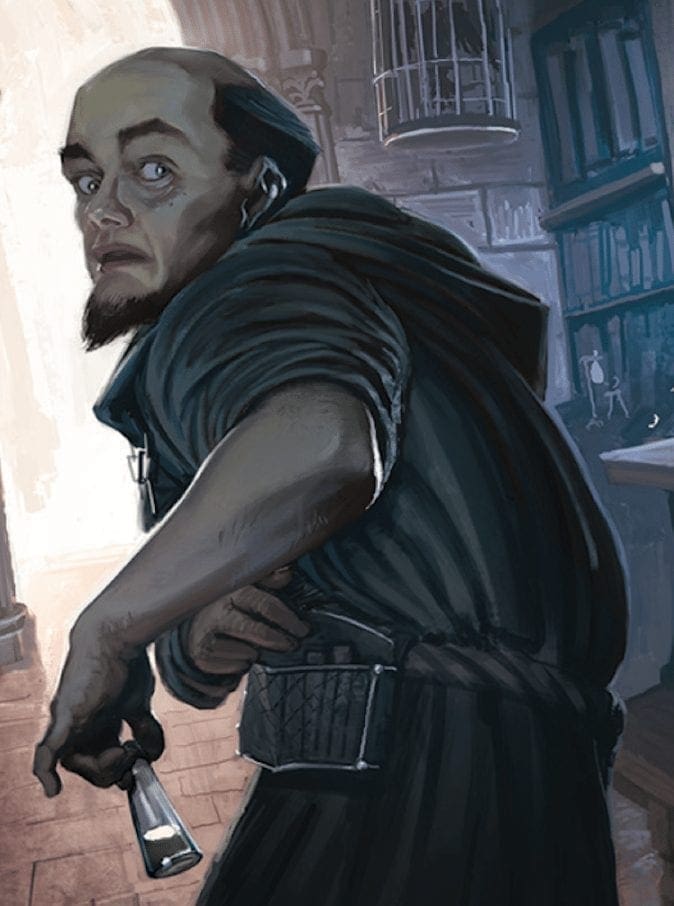
 As you can see, this sneaky fellow isn’t a big fan of your plot text, and he’s going to sneak out of Shadows and wipe it off for a phase. He’s an interesting one, because unlike Gerris, he doesn’t have a direct “When he comes out of Shadows…” trigger. That said, he’s still an excellent Shadows card, both in thematics and utility: Since he’s neutral, your opponent might not be expecting him, figuring that you’ve got one of your faction’s Shadow cards hiding away instead. Then, he can pop out at an unexpected moment and wreak havoc on your opponent’s plans! I’ve made a short list of plots that I’m looking forward to blanking with this guy:
The Annals of Castle Black
A Game of Thrones

Besieged

Blood of the Dragon

Late Summer Feast (Your own!)

Forgotten Plans (Whose plans are forgotten now, huh?!)

For the Watch!

The Red Wedding

Wardens (ALL OF THEM! Muhahaha!) Let me know if I missed your favorite in the comments!



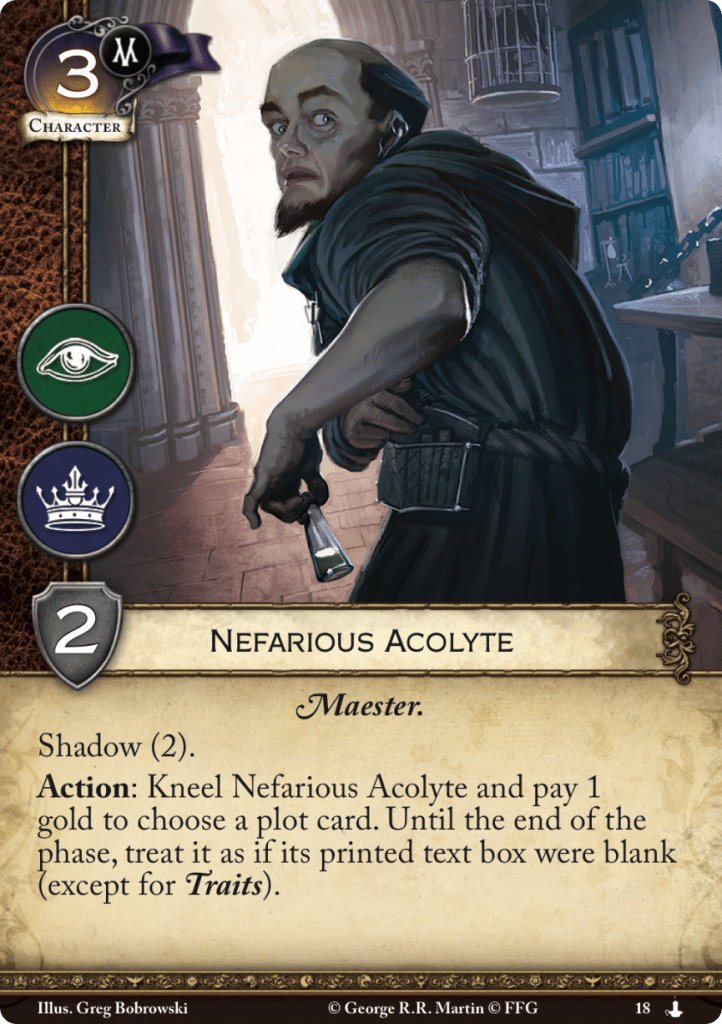
Great write up, @Chris Schoenthal. I’m really intrigued by that Nefarious Acolyte. A few more very reasonable Maesters like this look to help The Conclave agenda be a more practical option, but most importantly that’s a huge meta tech ability there. Astute players could have a lot of upside in blanking out an opponent’s plot at a key moment. In particular, I think people will be eager for the effect it has in tempering The Annals of Castle BlackThe Annals of Castle Black (GtR) Neutral Plot Income: 4. Initiative: 4. Claim: 1. Reserve: 7. Plot deck limit: 2. Legacy. Each… Read more »
Certainly a fair point about LSF, although I’ve found myself using two in some decks. A better example of a plot that could be used without a downside was given in the Facebook group (Sneak Attack)
I mean, yes you note some differences between Shadows and Ambush but aren’t they all net positives for Shadows? It seems that Ambush is inferior in every regard.
Yes, that would be my general conclusion. Whether that’s a positive or negative overall is up for personal interpretation.
It’s a negative. Why push for new mechanics that are strictly superior to the original ones? And these will rotate out. Why not put these in the base set?
To the first question: I’d say because they are superior in ways that are compelling and make for more interesting game play.
To the second question: I wish they had, as I mention 🙂 If I had to guess, I’d say that they felt that if Shadows started out in the game, people would be concerned that it was relying too heavily on 1E as a crutch.
Good write-up of the mechanic. And real nice spoiler. Excited to try him out.
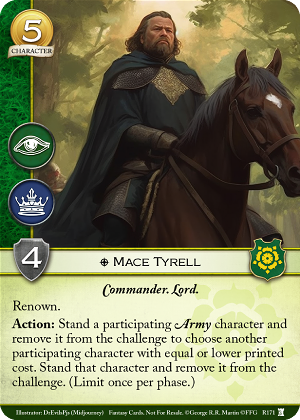
Another thought that occurs to me about Ambush v Shadows is in regards to house themes. At first, Lannister was described as being the kings of the Ambush keyword, though it was supposed to appear in small amounts in other houses as well. In the ensuing time, however, we’ve really seen Ambush move hard into Tyrell and Martell and I would argue that Lannister has really lost their kingship of this keyword. Is it possible that we could see Shadows pushed hard in Lannister to have them take over as kings of the Shadows keyword? Thematically, I think that would… Read more »
For what it’s worth, Lannister has 9 cards with Ambush currently, Tyrell is next with 5, then Martell with 4, so they’ve got a much larger stable. It just seems like the Martell and Tyrell ambush cards are in large part generally useful, and also synergize with in-house strategies better than the Lannister ones do. Outside of clansmen decks, do any of the Lanni ones see play aside from the Hound?
It probably also “feels” like Martell has more Ambush cards, because they have effects such as Core Arianne that mimic it without having the actual keyword. In terms of playability, Burned Men are still a staple in a lot of Lannister decks, and Widow’s Wail, while it’s getting squeezed out now due to overall card quality, was a common include previously as a surprise pump.
I think both of you are on to something here. While Lannister has a higher number of total Ambush cards, most of them are played very little now aside from the Hound. A handful of others see play, but not with the same regularity. On the other hand, the Ambush cards that Tyrell and Martell have see quite a lot of play at the moment. As well, theirs all trigger via “enters play” rather than only triggering via Ambush, so we’re likely to see their effects utilized via Mace, Arianne, and Flea Bottom, which increases both their reliability and number… Read more »